




You can find a convenient guide on container capacity below. Please note that in addition to these standard sizes, we can also provide shipping instructions for all types.It is an indispensable and important tool in international ocean freight shipping.
Welcome to contact us for accurate and detailed information about con-tainer loading.
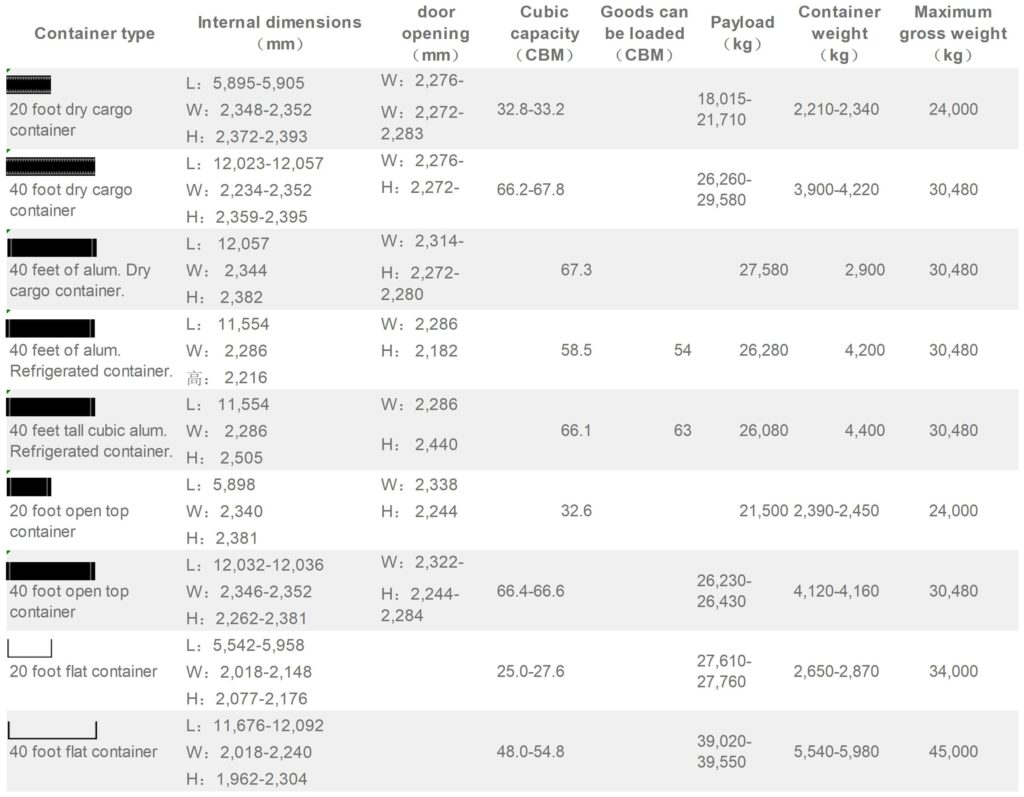
Container Specifications: 20GP, 40GP, 40HQ and 45HQ
All standard dry containers follow the ISO 668 dimension standard, but the numbers that matter for loading are the internal dimensions, not the nominal size. The table below lists the figures we use when planning a load.
| Parameter | 20GP | 40GP | 40HQ | 45HQ |
|---|---|---|---|---|
| Internal L x W x H (mm) | 5,898 x 2,352 x 2,393 | 12,032 x 2,352 x 2,393 | 12,032 x 2,352 x 2,698 | 13,556 x 2,352 x 2,698 |
| Door W x H (mm) | 2,340 x 2,280 | 2,340 x 2,280 | 2,340 x 2,585 | 2,340 x 2,585 |
| Nominal volume | 33.1 CBM | 67.5 CBM | 76.0 CBM | 86.0 CBM |
| Practical loading volume | 26-28 CBM | 56-58 CBM | 66-68 CBM | 75-78 CBM |
| Tare weight | ~2,200 kg | ~3,750 kg | ~3,900 kg | ~4,200 kg |
| Max gross weight | 30,480 kg | 30,480-32,500 kg | 30,480-32,500 kg | 32,000 kg |
Why Practical Loading Volume Is Lower Than Nominal Capacity
Nominal capacity assumes every cubic centimetre is filled. In practice carton gaps, pallet footprint, the loading sequence and lashing materials consume 10-15% of the space, so a 40HQ that “officially” holds 76 CBM realistically carries 66-68 CBM. Plan your order quantities on the practical figures in the table above.
Three Weight Limits Apply at the Same Time
- Container plate limit – maximum gross weight (typically 30,480 kg) minus tare weight.
- Carrier limit – most shipping lines cap a 20GP at 21-28 tonnes of cargo and a 40GP/40HQ at 24-26 tonnes.
- Road limit at destination – for example, standard US inland chassis typically allow around 17.2 t for a 20ft and 19.9 t for a 40ft; above that you need costly tri-axle equipment.
Always plan for the strictest of the three, and submit an accurate VGM (Verified Gross Mass). A VGM error beyond tolerance means the container is rejected at the terminal gate.
Choosing the Right Container
- Heavy, dense cargo (ceramics, tiles, machinery) – 20GP. Payload is close to a 40ft but volume is half, so you fill the weight before the space.
- Light, bulky cargo (furniture, garments, toys) – 40HQ. It adds roughly 9 CBM over a 40GP for a small freight difference.
- Mixed cargo – calculate both density (kg per CBM) and pallet fit. Two standard pallets fit side by side in the 2.35 m internal width.
- Oversized cargo – Open Top or Flat Rack; send us the dimensions for a special equipment quote.
Loading Best Practices From Our Warehouse
- Check the door aperture, not just the internal height: the door is 5-10 cm lower, so tall machinery must pass through it.
- Spread weight evenly across the floor; concentrated point loads damage floorboards and lead to claims.
- Use dunnage bags or air bags to stop cargo shifting in transit.
- Wooden packaging for the US, EU and Australia must be ISPM-15 heat-treated and stamped, or customs will quarantine it.
- Photograph the loaded container before sealing – it is your best evidence if a damage claim arises.
Frequently Asked Questions
How many CBM fit in a 20ft container?
The nominal volume is 33.1 CBM, but realistic loading is 26-28 CBM once packing gaps and pallets are accounted for.
What is the difference between a 40GP and a 40HQ?
Only the height: a 40HQ is about 30 cm taller internally, which adds roughly 9 CBM of capacity – often for a similar freight rate, making it the first choice for light cargo.
How much weight can a 40HQ carry?
The container plate allows around 26.5 tonnes of cargo, but carrier limits and destination road limits are usually stricter – plan for 24-26 tonnes and confirm with us before loading.
Related reference pages
Need something more specific? Send us your shipment details and we will reply within 24 hours.