





China to Europe Consolidation DDP: Combine Parcels, Cut Costs, Clear Customs Clean
1. Introduction: Why Consolidation + DDP Is the Smart Setup for EU Buyers in 2026
From 1 July 2026, the European Union’s long-standing customs duty exemption for low-value consignments comes to an end. Every consignment valued up to €150 imported from outside the EU can now attract a temporary flat €3 customs duty per item, charged according to tariff classification, while import VAT continues to apply from the first euro through the IOSS system. For buyers who source from Taobao, 1688, Pinduoduo and a dozen separate Chinese suppliers, that new reality turns a pile of small parcels into a pile of separate customs declarations, repeated minimum freight charges and repeated first-weight fees.
This is exactly the problem that China to Europe consolidation DDP solves. Instead of letting ten sellers ship ten parcels that clear customs ten times, your goods are collected at one dedicated China warehouse address, inspected, combined into a single consolidated shipment, repacked to remove dead weight, and dispatched under one DDP arrangement — the forwarder handles export formalities, EU import clearance, duty and VAT payment, and final DPD or DHL delivery to your door. One box, one declaration, one tax settlement, one tracking thread.
In this guide we explain how consolidation shipping to Europe works step by step, why the 2026 €3-per-item rule makes combining parcels materially cheaper, which transport channels fit which weight and timeline, how VAT and IOSS are handled on consolidated declarations, and how to choose a reliable Europe consolidation DDP service. Whether you are an individual buyer accumulating a Taobao haul or an Amazon FBA seller restocking from multiple 1688 suppliers, the logic is the same: combine parcels, cut costs, clear customs clean.
2. What Is China to Europe Consolidation DDP?
China to Europe consolidation DDP is the combination of two services that, stacked together, create a complete door-to-door chain for multi-seller purchases.
- Consolidation — also called parcel forwarding or package consolidation. You are given a dedicated China warehouse address with a personal receiving code. Every order you place, whether on Taobao, 1688, Pinduoduo, Tmall or directly with factories and trading companies, is delivered to that address in your name. The warehouse team receives, logs, inspects and photographs each item, stores it under your account, and on your instruction combines everything into the smallest possible number of export cartons.
- DDP (Delivered Duty Paid) — an Incoterm under which the seller-appointed forwarder takes responsibility for the entire transport chain, including EU import customs clearance and the payment of import duties and import VAT. Under a genuine DDP consolidation service, the consignee never contacts customs, never pays a surprise bill on the doorstep, and never chases a broker for a missing document.
Stacked together, the two services mean your multi-seller purchases are managed as one shipment from the China warehouse floor to your European address. The alternative — letting each Chinese seller post a separate small packet — means multiple airway bills, multiple minimum freight charges, multiple customs entries and multiple chances for something to go wrong. For repeat buyers and e-commerce sellers, consolidation DDP is not a premium extra; it is the operating model that keeps cross-border sourcing predictable. That end-to-end ownership is the promise of every credible Europe consolidation DDP service. You can read more about the broader setup in our overview of the China consolidation service, and our analysis of the three major consolidation modes compares the routing options in depth.
3. How Consolidation Works: Step by Step
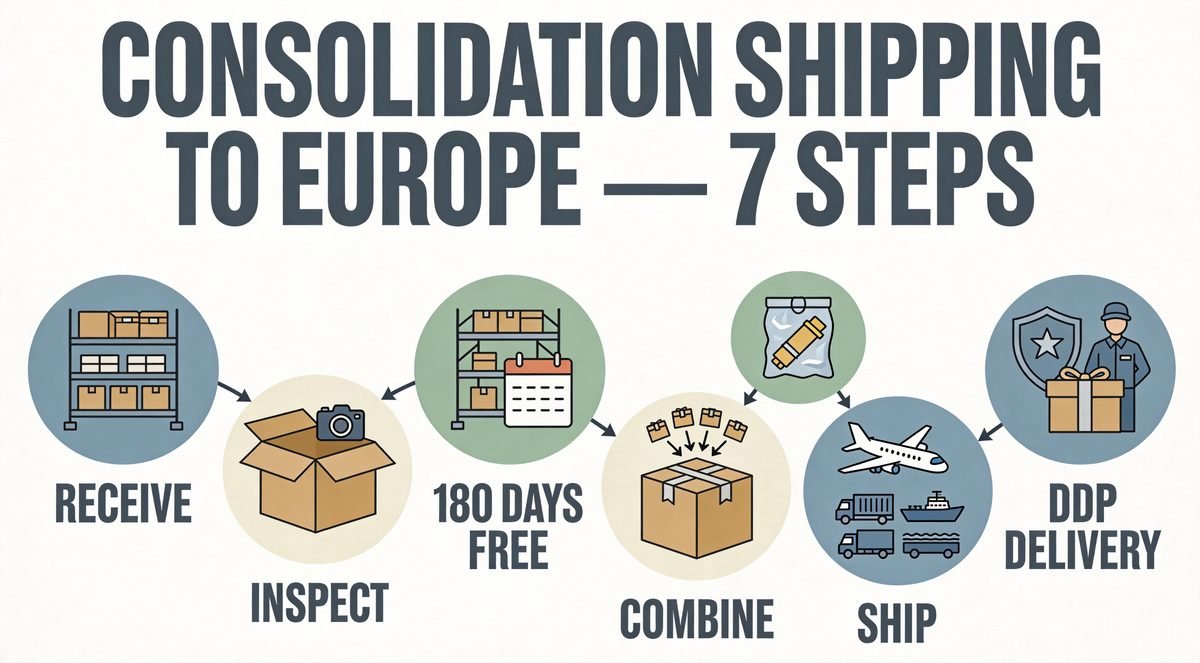
Every reliable Europe consolidation DDP service follows the same eight-stage flow.
- Get your dedicated China warehouse address. After registering, you receive a personal receiving code and a warehouse address that you enter as the delivery address at checkout on every Chinese platform. You never need to coordinate with individual sellers about international shipping.
- Shop across platforms and suppliers. Order on Taobao, 1688, Pinduoduo or Tmall, or buy direct from factories. Every seller ships domestically to the same address under your receiving code.
- Item-by-item receiving inspection. Each parcel is logged on arrival, opened, checked against your order and photographed. You review the photos and can flag defects, wrong items or shortages before anything moves internationally.
- Free storage while you accumulate. Items are held free of charge for up to 180 days, so you can gather orders placed weeks or months apart before dispatch.
- Combine and repack to cut chargeable weight. The team removes redundant shoeboxes and OEM filler, vacuum-compresses soft goods, reinforces fragile items, and packs everything into the minimum cartons — while keeping protective retail packaging, such as anti-static bags, intact.
- Choose your channel and dispatch. Air, truck, rail or sea is selected by weight, urgency and cargo type, and the cartons are exported under one set of shipping documents.
- EU customs clearance as one consignment. The DDP provider files a single import declaration, pays the flat €3 per-tariff-line duty where applicable, settles import VAT, and responds to customs queries on your behalf.
- Last-mile delivery. After release, the consignment is handed to established EU parcel networks — typically DPD or DHL — and delivered to your door with end-to-end tracking.
The entire sequence runs under one account and one tracking thread — a core advantage over juggling five unrelated parcel numbers from five sellers.
4. Why 2026 Makes Consolidation Smarter Than Ever
Three mechanics make the new EU customs environment reward consolidated shipping, and they all flow from the same principle: one consolidated consignment replaces many separate ones.
The €3 duty is charged per tariff line. Under the EU’s new temporary measure for low-value e-commerce imports — consignments valued up to €150 — each item attracts a flat €3 customs duty based on its tariff classification. Simplified H7 declarations classify goods at the 6-digit HS code level, while standard H1 declarations classify at the full 10-digit TARIC level. The practical point for shippers: within one consignment, items falling on the same tariff line are counted together — one line, one €3 charge. Ship five identical garments as five separate parcels and they are five consignments with five separate charges; combine them into one consolidated DDP consignment and they sit on a single tariff line, declared once. Fewer consignments and fewer tariff lines mean fewer flat-duty charges. The European Commission sets out the full customs reform background on its official EU customs reform page.
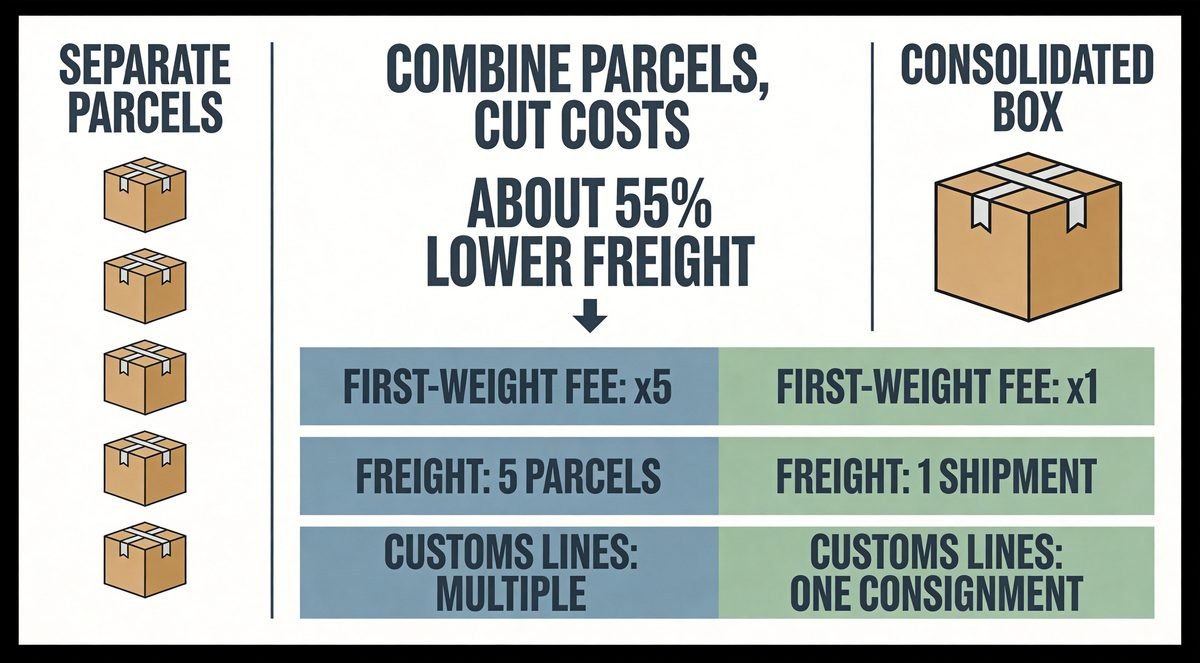
Repeated first-weight charges disappear. Every small parcel is billed with a minimum first-weight unit — typically the first 0.5 kg — plus incremental weight beyond it. Five separate 0.5 kg parcels each pay a full first-weight charge; the same five items combined into one 2.5 kg consolidated carton pay a single first-weight charge plus only the incremental weight. On typical consolidation rates, that structural difference works out to roughly 55% lower freight on small multi-item hauls — and that is before the extra savings from repacking, which removes packaging dead weight and shrinks volumetric weight. No per-kilogram quote changes the arithmetic: fragmented shipping is most expensive at the first-weight step, and consolidation removes the repetition.
One declaration means less inspection friction. Five parcels mean five manifests, five customs risk scores and five opportunities for a hold, a document request or a mis-declared HS code. A consolidated DDP shipment is one entry, prepared by a professional declarant with a consistent commercial invoice, packing list and SKU-level HS mapping. Clean paperwork is the single best predictor of fast release — and under China to Europe consolidation DDP, the provider’s clearance team owns the response to customs, not you.
Add it up — fewer tariff-line charges, no repeated first-weight fees and one professionally managed declaration — and consolidation DDP becomes the default smart choice for 2026 EU sourcing.
5. Shipping Channels for Consolidated Cargo
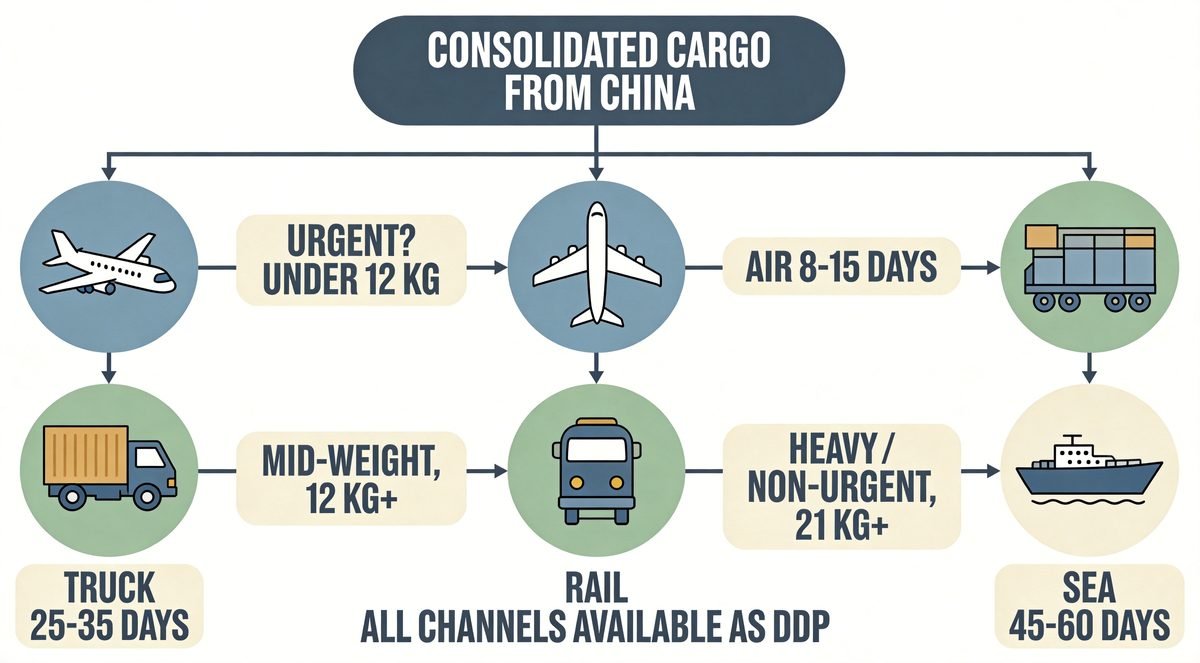
Once your items are combined, your Europe consolidation DDP service offers four trunk channels. The choice is driven by weight, urgency and cargo type.
| Channel | Door-to-door transit | Typical weight fit | Best for |
|---|---|---|---|
| Air consolidation | 8–15 days | Small parcels, roughly under 10–12 kg | Samples, urgent 3C accessories, small high-value hauls |
| Truck freight | 25–35 days | 12 kg and up | Furniture, bulk apparel, household goods, mid-size appliances |
| Rail LCL (China–Europe rail) | 18–25 days | Mid-weight consolidated cartons | Balanced speed and cost for planned restocks |
| Sea consolidation | 45–60 days | 21 kg and up, heavy or bulky cargo | Large restocks, palletized inventory, non-urgent goods |
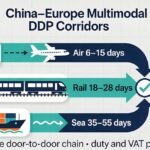
Air is the workhorse for personal buyers and sample orders: consolidated small parcels clear fast and arrive in around 8–15 days, and dedicated sensitive-cargo air lines exist for battery products and cosmetics. For heavier commercial volumes, truck freight to Germany, France, Italy, Spain and other EU markets offers the best balance of cost and capacity for consignments from 12 kg upward. Rail LCL via China–Europe block-train services splits the difference at 18–25 days — slower than air, faster and cheaper than sea for mid-weight loads. Sea consolidation wins purely on cost for planned, non-urgent inventory of 21 kg or more. For air-focused detail, our guide to the European air freight DDP special line covers the air lane in depth; for the adjacent market, our small parcel air freight to Türkiye DDP guide explains the neighboring route.
6. What Goods Can Be Consolidated? Cargo Rules for Consolidation DDP
General cargo is fully accepted on standard consolidation lines: apparel and footwear, home textiles and household goods, 3C electronics and accessories, auto parts and accessories, toys, stationery, tools and general merchandise. These travel with no special paperwork beyond accurate invoice descriptions and correct HS classification.
Sensitive goods move on dedicated special channels. Products with built-in lithium batteries, cosmetics and skincare, liquids, creams, powders and similar items cannot travel on standard general-cargo lines, but they are accepted through special-channel consolidation DDP arrangements — usually supported by MSDS documentation, UN38.3 test reports for cells and batteries, and compliant packaging. Declare these items at booking; an undeclared battery discovered at customs is a seizure risk, not a delay risk.
Prohibited items are non-negotiable: counterfeit or trademark-infringing goods, food and supplements without the required EU certification, hazardous chemicals and dangerous goods outside regulated dangerous-goods procedures, weapons and illegal items. The European Commission publishes the official framework on its customs prohibitions and restrictions page. When in doubt about a category, confirm it in writing with your forwarder before you buy.
7. EU Warehouse Staging: Bulk Clearance, Local Distribution
For e-commerce sellers, consolidation does not end at the EU border. After a bulk China to Europe consolidation DDP consignment clears into free circulation, it can be staged at our EU transit warehouse for value-added handling before final distribution.
Typical staging operations include: relabeling cartons and units for destination marketplaces; repalletizing to Amazon FBA or retailer pallet specifications; booking FBA delivery appointments and verifying carton and pallet labels against receiving rules; and deconsolidating one bulk shipment into split dispatches to fulfillment centers, B2B buyers or end customers across multiple EU countries. Inventory can also be held locally for Shopify order fulfillment, turning long China lead times into short local delivery windows.
This model suits Amazon FBA and Shopify sellers who source repeat SKUs from several Chinese suppliers: ship once in bulk under one Europe consolidation DDP arrangement, clear customs once, then distribute locally with short lead times and full appointment control. It converts fragmented parcel-level risk into controlled bulk inventory.
8. VAT & Duty Handling for Consolidated Shipments
Tax handling is where a DDP consolidation service earns its fee. Four points matter.
- IOSS for low-value consignments. Import VAT on consignments up to €150 is collected at point of sale under the Import One-Stop Shop (IOSS) system; non-EU sellers using IOSS must appoint an EU-established intermediary. The European Commission’s official VAT One Stop Shop portal is the authoritative reference for how the scheme works.
- How IOSS applies to a consolidated parcel. A consolidated consignment is declared under one IOSS identification number by the party responsible for the declaration — typically the DDP provider or its appointed intermediary. The commercial invoice must show SKU-level detail so that every item’s value is transparent to customs.
- DDP consolidation versus self-clearance. Under DDP consolidation, the forwarder or its EU entity acts as importer of record using its own EORI, carries the duty and VAT risk, and includes taxes in the delivered price. Under self-clearance (DDU or importer-led POA clearance), you or your entity are the importer: you need your own EORI, your own broker and your own VAT recovery path. Ask any provider explicitly whose EORI and IOR the shipment uses — a vague answer is a red flag.
- Invoice discipline. Consolidated declarations live or die on documentation. The commercial invoice should list every SKU with a plain-language description, HS code, quantity, unit value and total value, and a packing list reconciling carton by carton. Under-declared values trigger reassessment, holds and penalties far larger than the tax “saved.”
Remember that the flat €3 duty sits alongside VAT, not instead of it: duty is determined by tariff line, VAT by value and the destination member state’s rate. A competent consolidation DDP provider calculates both before dispatch, so your landed cost is known upfront rather than negotiated at your doorstep. For most non-EU sellers, this makes consolidation shipping to Europe under DDP the only practical route with taxes truly settled upfront.
9. Choosing a Reliable Consolidation Partner
A DDP promise is only as good as the operation behind it. Evaluate any China to Europe consolidation DDP partner against five criteria.
- Real inspection standards. Item-by-item photos on arrival and a full packing video before dispatch. If you cannot see your goods before they leave China, you cannot dispute their condition later.
- Genuine repackaging capability. Volume reduction, vacuum compression of soft goods, fragile-item reinforcement — and the judgment not to strip anti-static protection from electronics or original packaging that affects resale value.
- Sensitive-goods channels. A partner that moves batteries, cosmetics and liquids on documented special lines, rather than rejecting them outright or quietly mis-declaring them as general cargo.
- A transparent DDP tax path. They can explain whose EORI and IOR are used, how IOSS is applied, who acts as the EU intermediary, and what the €3 duty and VAT treatment will be on your specific SKU mix. If a Europe consolidation DDP service cannot answer these questions, it is learning on your cargo.
- Tracking and claims. One tracking thread from warehouse receipt to proof of delivery, milestone alerts, published compensation rules for lost or damaged items, and responsive English-language support.
Price comparison across providers is meaningless without these five. A slightly higher freight quote from a partner who inspects, repacks, declares cleanly and answers tax questions openly beats a cheap rate that strands your cargo at customs. Choose your China to Europe consolidation DDP partner on that basis, not on headline price alone.
10. Conclusion: One Box, One Declaration, One Delivered Price
The 2026 EU customs changes reward structured shipping. Fragmented small parcels face repeated flat duties, repeated first-weight charges and repeated customs risk; China to Europe consolidation DDP converts the same goods into one consolidated, repacked, professionally declared shipment with duty and VAT settled before delivery. You buy from any Chinese platform or supplier; your dedicated China warehouse and your DDP forwarder handle the rest.
Ready to combine your next Taobao, 1688 or supplier orders into a single DDP shipment? Send us your item list, weights and destination country for a channel recommendation and a consolidated DDP quote — and stop paying per-parcel customs.
Frequently Asked Questions
Q1: After parcels are consolidated, how is the €3 duty calculated?
The flat €3 duty applies per tariff classification line per consignment. On a consolidated DDP consignment, all items are declared together: goods sharing the same 6-digit HS line under an H7 simplified declaration, or the same 10-digit TARIC line under an H1 standard declaration, are counted on that single line — so identical or same-category goods incur one charge rather than one per original parcel. Your DDP consolidation provider builds the line-by-line breakdown from the SKU-level invoice.
Q2: Is combining goods from multiple sellers into one customs declaration risky?
Not when the declaration is prepared professionally. Consolidated declaration is legal and standard practice; the requirements are an accurate commercial invoice listing every seller’s items with correct values and HS codes, a matching packing list, and a responsible importer of record. The risk comes from vague descriptions or under-declaration — which is exactly why item-level inspection and SKU-level documentation matter. One clean consolidated entry faces less friction than five weak ones.
Q3: Can I use my own IOSS number on a consolidated parcel?
Typically, no. The IOSS number on a consignment belongs to the party making the declaration and carrying responsibility for the VAT. Under a DDP consolidation service, the provider or its EU intermediary declares under its own IOSS arrangement because it acts as importer of record. If you are a VAT-registered seller who wants to use your own IOSS, raise it before booking: that usually means a self-clearance structure under your own EORI rather than standard DDP.
Q4: Can sensitive goods like battery products or cosmetics go via consolidation DDP?
Yes — through special-channel consolidation shipping to Europe. Products with built-in batteries, cosmetics, liquids and powders are rejected by standard general-cargo lines but accepted on dedicated sensitive-goods channels, usually with MSDS documentation and UN38.3 test reports for batteries. Loose lithium cells and certain categories require full dangerous-goods handling; counterfeits, uncertified food and hazardous chemicals cannot ship at all. Always declare sensitive items at the booking stage.
Q5: How long does free storage last?
Standard free storage at the consolidating China warehouse — typically included with every Europe consolidation DDP service — runs up to 180 days per item. That window lets you accumulate orders from multiple platforms and suppliers over weeks or months, wait for restocks, and time your consolidated dispatch to your inventory needs or personal schedule. Beyond the free period, extended storage terms apply — ask your provider for its exact policy.