







Lebanon Air Freight DDP: Fast Door-to-Door Shipping from China to Beirut Airport (BEY)
When a production line in the Bekaa Valley is waiting on a replacement servo motor, when a Beirut electronics distributor needs a restock before the weekend retail rush, or when a hospital has a patient-dependent medical device on order, sea freight’s 25–35 day transit is simply not an option. Air freight exists for exactly these shipments: high-value consumer electronics and telecom gear, medical equipment and pharmaceuticals, time-critical industrial spare parts, trade-show and sales samples, and small cross-border e-commerce batches that cannot afford a month on the water. Air cargo also carries the lowest inventory-in-transit risk, which is why most importers use it to launch new product lines or bridge stock-outs while a sea shipment is still sailing.
The core value of a Lebanon air freight DDP (Delivered Duty Paid) service is that the forwarder takes responsibility for the entire chain under one contract: pickup anywhere in China, export declaration, airline booking and security screening, transit through Gulf or Turkish hubs, Lebanese import customs clearance, duty and VAT payment, and final delivery to the consignee’s door. For an importer who has never registered with Lebanese customs — or who simply does not want to chase brokers, permits and payment slips at Beirut airport — DDP converts a fragmented, document-heavy process into a single handover at the Chinese factory and a single confirmed delivery in Lebanon. The price you agree before departure is the price your business pays, with duties, taxes and destination fees already inside it.
This guide walks through how China to Lebanon air freight actually works in 2026: the BEY gateway and its transit hubs, realistic transit times and service tiers, how air compares with sea and express, customs clearance mechanics at Beirut airport, the new mandatory consignee tax reference rule that applies to air waybills too, the full document set, the door-to-door DDP flow, sensitive-cargo handling, and the surcharges that quietly inflate non-DDP quotes.
1. When Air Freight to Lebanon Is the Right Call — and Why DDP

2. Beirut-Rafic Hariri Airport (BEY): Lebanon’s Only Major Air Cargo Gateway
Virtually all scheduled international air cargo entering Lebanon lands at Beirut-Rafic Hariri International Airport (BEY), located roughly nine kilometres south of central Beirut. It is the country’s sole major air freight gateway; no other Lebanese airport handles meaningful wide-body or freighter traffic, so every air shipment — whether booked under a master air waybill or arriving as an express parcel — funnels through BEY’s cargo terminal for customs inspection and release.
A point that often surprises first-time shippers: there are no scheduled direct freighter or cargo-capable passenger services from mainland China to Beirut in 2026. The overwhelming majority of China to Lebanon air freight transships through one of three regional hubs:
- Dubai (DXB / DWC) — Emirates SkyCargo and partner feeders, the busiest transit lane for southern China departures;
- Doha (DOH) — Qatar Airways Cargo, with strong connections from Guangzhou, Shanghai and Hong Kong;
- Istanbul (IST) — Turkish Cargo, frequently the fastest routing for northern and eastern China origins and a common alternative when Gulf capacity is tight.
Secondary routings occasionally run via Abu Dhabi (AUH), Amman (AMM) or Cairo (CAI). At the hub, cargo is transferred between aircraft under interline agreements, which is why airport-to-airport transit takes several days even though total block flying time is only around 14 hours. Forwarders with fixed weekly EK/QR/TK allocations avoid the peak-season waits that ad-hoc bookings face at the transit hub.
3. Transit Times and Service Tiers
Three service tiers cover nearly every air shipping to Lebanon scenario:
| Tier | Typical Transit | Minimum Weight | Ends At |
|---|---|---|---|
| Standard air freight (airport-to-airport) | 3–7 days from PVG/CAN/SZX/HKG/PEK to BEY | ~45 kg chargeable weight | BEY cargo terminal |
| Air freight DDP door-to-door | 5–10 days | ~45 kg | Consignee’s address |
| International express (DHL / FedEx / UPS) | 3–5 working days door-to-door | From 0.5 kg | Consignee’s address |
The 3–7 day airport-to-airport figure covers flight connections plus hub transshipment. Door-to-door DDP adds Chinese inland pickup and export declaration (usually 1–2 days), plus Lebanese clearance and last-mile delivery (typically 1–3 days). Express is fastest end-to-end for small parcels because couriers move consolidated bags on their own networks, but transit times published by carriers are estimates, not guarantees — and capacity to Beirut can be suspended or rerouted with little notice during regional disruptions.
Weight thresholds drive the choice. Airline and consolidated air freight generally becomes practical at 45 kg and above per shipment; below that, the fixed airport and documentation costs make express cheaper per shipment. Express accepts consignments from 0.5 kg, making it the natural channel for documents, samples and warranty replacements. For medium-weight urgent cargo — say 80–500 kg of electronics or accessories — consolidated air freight offers the best balance, and a Lebanon air freight DDP booking wraps clearance and delivery into the same price. Shippers who want to understand the cost difference between direct master-AWB bookings and consolidated loading should review our explanation of the three major consolidation modes.
4. Air vs Sea vs Express: How to Choose
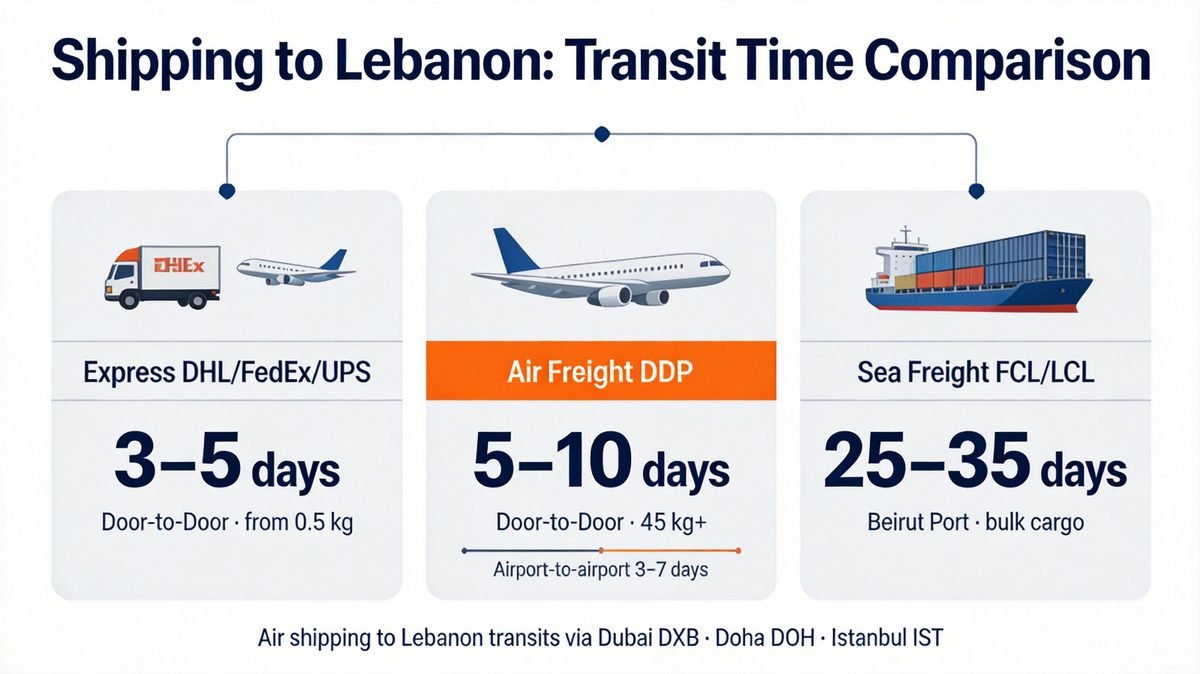
Each mode has a clear sweet spot. The table below summarizes the trade-off for Beirut airport cargo and Beirut port cargo alike.
| Mode | Transit (China → Lebanon) | Cost Tier | Best For | Customs Responsibility |
|---|---|---|---|---|
| Express courier | 3–5 workdays, door-to-door | Highest per kg | Urgent parcels, documents, samples under ~50 kg | Carrier manifest; consignee or DDP broker clears |
| Air freight | 3–7 days airport / 5–10 days door | Mid-high | 45 kg–500 kg urgent or high-value goods | Forwarder; DDP available |
| Sea freight (FCL/LCL) | 25–35 days FCL / 30–45 days LCL to Beirut Port | Lowest per unit | Bulk, heavy, non-urgent cargo above ~1–2 CBM | Consignee or DDP forwarder |
The practical rule of thumb: under 50 kg and genuinely urgent, use express — but check the destination risk surcharge discussed in section 9 before you commit. Medium-weight urgent cargo (roughly 50 kg to half a tonne) goes by air freight, where the per-kilogram rate drops sharply versus courier sheets. Bulk, heavy or non-time-sensitive cargo — furniture, building materials, machinery, full e-commerce replenishment containers — goes by sea. Mixed strategies are common: air-freight the first batch to capture the sales window, then sea-freight the follow-up stock.
The same DDP door-to-door logic applies across the region. If your distribution also covers Iraq, our Iraq sea and air door-to-door services run on an identical all-in model; for small-parcel flows into neighbouring Turkey, see our small parcel air freight to Turkey DDP service; and buyers comparing Mediterranean routings can benchmark against our European air freight DDP special line. For DDP air cargo Middle East destinations generally, the customs-document discipline described below is what separates a 5-day shipment from a two-week hold. That is why a properly scoped Lebanon air freight DDP service audits and pre-clears the document pack while the cargo is still in the air.
5. Air Freight Customs Clearance at BEY
Customs clearance at BEY normally adds 1–2 days to the air transit. Shipments with complete, consistent documentation commonly clear within 24–72 hours of arrival; missing papers, HS-code disputes, physical inspection or customs re-valuation of the declared CIF value can stretch that to a week or more, with warehouse storage accruing after the terminal’s free period.
Cost categories at the airport (quoted case by case, never as a blanket figure) include: the ground handler’s terminal and warehouse handling charges, the air waybill / documentation fee, the licensed customs broker’s clearance fee, and storage charges once free time expires. Under a Lebanon air freight DDP arrangement, every one of these charges is settled by the forwarder before cargo release — the consignee never receives an unexpected terminal invoice.
A critical rule for express users: shipments arriving in commercial quantity — judged by item count, repetitive shipments and/or value — are treated as commercial consignments and must go through commercial clearance, regardless of how they were booked. A 200-piece “sample” order on a courier account does not stay in the simplified lane.
For genuine personal courier shipments, Lebanese practice sets two practical thresholds: consignments with a CIF value below roughly USD 130 can normally be released through the simplified/consolidated declaration channel (though customs officers retain the right to re-estimate value and require formal entry), while shipments above roughly USD 980 require formal clearance with the importer’s ID copy and a signed authorization to the clearance broker. On the duty side, Lebanon applies HS-code-based tariffs of typically 5–15% of CIF value, plus VAT at 11% on most imports; the CIF base includes goods cost, insurance and freight to Lebanon, and customs may re-evaluate declared values against its own records. A Declaration of Value (DEV) form is required for imported goods valued at USD 3,500 or more. Aramex’s Lebanon country customs information page documents these thresholds and document requirements in detail.
6. The 2026 Tax Reference Rule — It Applies to Air Waybills Too
The single most important 2026 compliance change for Beirut airport cargo: from 13 July 2026, the consignee’s tax reference number is strictly mandatory on all shipments to Lebanon. The rule follows the amendment of Article 67 of the Customs Law (pursuant to Decree No. 4461), and carriers are obliged to submit the import manifest — sea and air — with the tax reference within the manifest submission deadline. The official carrier advisory on the mandatory Lebanon consignee tax reference sets out the same requirement that airlines and air-cargo terminals enforce on the air side.
The format is unforgiving. The number must always begin with 601, followed immediately by a hyphen, then exactly 8 digits (pad with leading zeros), for a total of 12 characters including the hyphen: for example, 601-12345 becomes 601-00012345, and 601-123 becomes 601-00000123. Shipping instructions submitted through carrier portals, INTTRA or EDI channels will be rejected if the reference is missing or malformed, and cargo whose compliant shipping instructions are not filed by the deadline will be rolled. Once the manifest is submitted, tax-reference amendments are no longer accepted; discrepancies become the consignee’s problem to resolve directly with customs.
This is where the DDP model removes a whole failure point. Under a Lebanon air freight DDP booking, the forwarder — through its licensed Lebanese entity and appointed broker — acts as importer of record (IOR), supplies the valid tax reference on the manifest and air waybill data, and files the entry. The overseas shipper and the Lebanese buyer never have to obtain, format or correct a 601-number under manifest-deadline pressure; SI rejection and roll-over risk sit with the party that runs the compliance process every day.
7. Documents for Air DDP Shipments to Lebanon
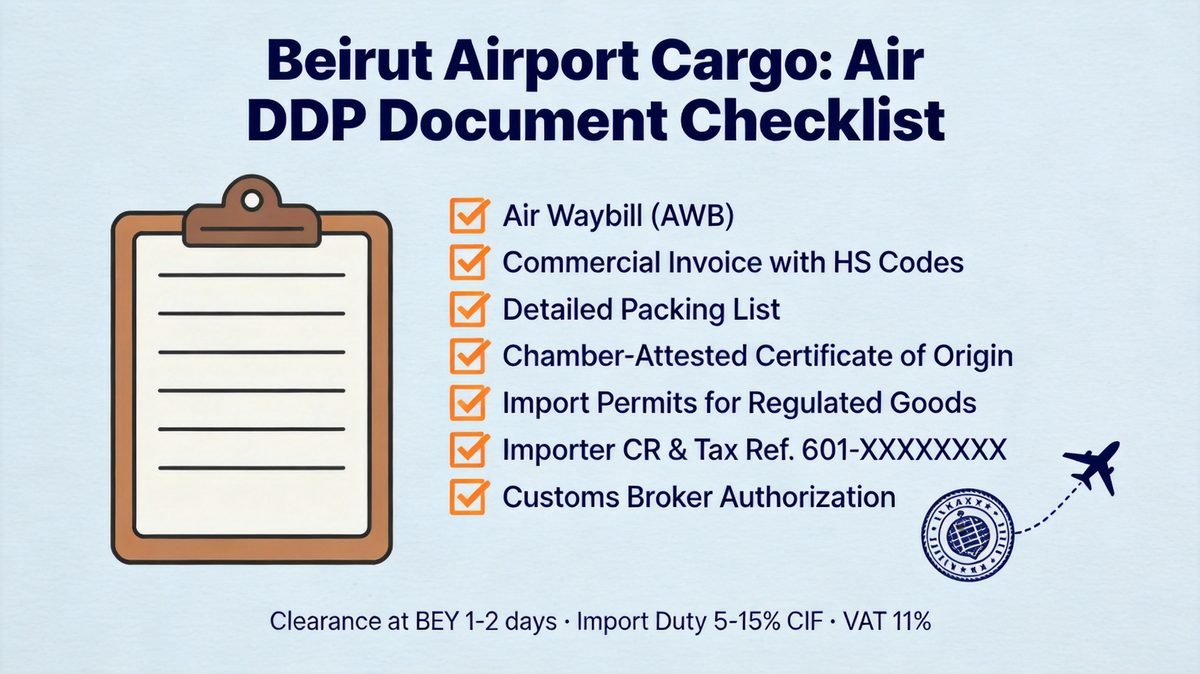
Lebanese customs runs on paper-heavy, original-document discipline. The standard document set for a commercial Lebanon air freight DDP shipment includes:
- Air Waybill (AWB) — the master AWB from the airline and the house AWB from the forwarder;
- Commercial Invoice — detailed and original, stating the HS code for every line item, plus weight, quantity, full goods description, origin and value; invoices should reflect the true transaction price because customs re-valuation is routine;
- Packing List — detailed, line-by-line, matching the invoice;
- Certificate of Origin — an original attested by a chamber of commerce (or other competent authority); a plain COO is not sufficient for preferential or formal entry;
- Import permits / ministry approvals for regulated goods — telecom equipment and mobile phones, pharmaceuticals and medical devices, cosmetics, and foodstuffs (with health/sanitary certificates where applicable);
- Importer qualification file for corporate consignees — Commercial Register (CR) copy, commercial circular, valid clearance certificate from the National Social Security Fund, financial register from the Ministry of Finance, ID copy of the authorized signatory, and the signed authorization to the customs clearance broker;
- Clearance and value forms — the importer/broker identification clearance form, and the Declaration of Value (DEV) form for consignments at or above USD 3,500.
Air freight moves fast, so documents must move faster: the DDP forwarder pre-audits the invoice and packing list before the goods leave China — a defect discovered at BEY burns exactly the days the customer paid air freight to save.
8. The DDP Air Door-to-Door Flow, Step by Step
A Lebanon air freight DDP shipment moves through five controlled stages:
- China pickup and intake. The forwarder collects from the factory or supplier warehouse across China’s main manufacturing regions, records 3D volume and actual weight, photographs the cargo, and applies graded packaging — anti-static wrap and pallets for precision instruments, reinforced cases for liquids, clearly marked shipping labels with consignee details.
- Export declaration, security screening and booking. Export customs declaration is filed, cargo passes airline security (X-ray; magnetometer checks where applicable), and space is locked in advance with EK/QR/TK or partner carriers so peak-season rolling is avoided.
- International carriage and transit. The ULDs fly to DXB, DOH or IST and transfer to the Beirut-bound leg, with milestone tracking at each node.
- BEY arrival, clearance and tax payment. The manifest is filed with the mandatory 601 tax reference; the broker lodges the customs declaration; duties (typically 5–15% of CIF by HS code) and 11% VAT are settled by the forwarder under the DDP terms; cargo is released after any inspection.
- Last-mile delivery. Released goods truck out of BEY for Beirut metropolitan delivery (same-day/next-day) or onward to Tripoli, Saida, Zahle and the rest of the country, generally within 1–3 days of release.
Sensitive cargo is handled, not refused, when documented correctly. Products with built-in lithium batteries (phones, laptops, power tools) ship with MSDS, UN38.3 test reports and IATA DGR-compliant packaging under PI967/PI966; standalone lithium batteries (PI965/UN3480) require full dangerous-goods handling, CAO labels and state-of-charge control at or below 30%. Magnetic cargo needs shielding or a degaussing inspection report to pass airline magnetometer checks; cosmetics and liquids require MSDS and, for regulated formulations, ministry permits. Disclose sensitive attributes at booking — a battery discovered at screening is a refused shipment, not a surcharge.
9. Hidden Surcharges to Watch — and Why DDP All-In Pricing Is More Stable
Non-DDP air and express quotes to Lebanon routinely exclude cost categories that only surface after arrival:
- Fuel surcharges — airline and courier levies that float with jet-fuel prices and are revised several times a year;
- Security surcharges — standard add-ons applied by carriers on Middle East routings;
- “Elevated Risk” / restricted-destination surcharges — express carriers such as DHL classify Lebanon as an elevated-risk destination due to regional conditions and add a per-shipment risk surcharge on top of the base sheet; some carriers apply a further restricted-destination fee;
- Remote-area delivery surcharges — for consignee addresses outside metropolitan Beirut;
- Terminal handling, documentation and storage fees at BEY once free time runs out.
Under carrier collect or DAP terms, these charges land on the consignee at the worst possible moment — cargo sits on the ground at BEY and will not be released until they are paid, and the final bill can differ sharply from the freight number quoted in Shenzhen. This is where a Lebanon air freight DDP all-in quotation earns its keep: freight, fuel and security components, clearance fees, duties, VAT and last-mile delivery are agreed in one figure before departure, so surcharge revisions between booking and delivery never become your emergency, and you compare suppliers on a single landed-cost number instead of stacking separate fee schedules.
10. Frequently Asked Questions
How long does air shipping to Lebanon take? Standard air freight from China to Beirut airport runs 3–7 days airport-to-airport; a complete DDP door-to-door service takes 5–10 days including pickup, export, transit, clearance and delivery. International express (DHL/FedEx/UPS) reaches Lebanese addresses in roughly 3–5 working days. All figures are estimates that can extend during hub congestion, peak season or customs inspection.
Why does my cargo transit through Dubai, Doha or Istanbul instead of flying direct? There are no scheduled direct China–Beirut freighter services in 2026. The region’s cargo networks are built around the Gulf hubs (DXB, DOH) and Turkish Cargo’s IST hub, where China-origin ULDs and bags transfer onto Beirut-bound flights. Routing via these hubs also gives forwarders daily or near-daily frequency, which keeps overall transit more reliable than waiting for thin direct capacity would.
Why did my express carrier add an “Elevated Risk” surcharge for a Lebanon delivery? Major couriers classify certain destinations as elevated-risk based on regional security and operating conditions, and Lebanon carries that designation with several carriers. The surcharge is applied per shipment on top of the standard express rate, alongside possible remote-area fees. Booking through a DDP air freight program avoids piecemeal surcharge shocks because all routing, risk and delivery components are consolidated into one agreed price.
Can I ship products with built-in batteries by air to Beirut? Yes, when compliance is handled properly: devices with embedded lithium batteries (PI967) and battery-packed equipment (PI966) move with MSDS, UN38.3 test summaries and DGR-compliant packaging; standalone lithium batteries (PI965/UN3480) are classed as dangerous goods and require full DG handling, CAO labeling and state-of-charge control. Magnetic goods, cosmetics and liquids each have their own screening and permit requirements. Declare all such cargo at booking so the correct screening and packaging are arranged in China.
How long does Beirut airport cargo customs clearance take? Clean, fully documented air shipments typically clear BEY in 24–72 hours, putting total clearance impact at 1–2 days within the door-to-door window. Delays occur when HS codes are missing or disputed, the tax reference is absent or wrong, values are re-assessed by customs, regulated goods lack permits, or cargo is selected for physical inspection. Pre-audited documents and a valid 601 tax reference — both handled inside the DDP service — are the two biggest levers for keeping clearance inside one day.
Ready to move urgent cargo from China to Lebanon without clearance surprises? Send us your cargo details — weight, dimensions, product type and Beirut delivery address — and our team will come back with a tailored Lebanon air freight DDP all-in door-to-door plan.