






Branded Goods Air Freight to the US: Duty-Paid (DDP) Clearance, Explained
Key takeaways:
- Branded goods air freight to the US with duty-paid (DDP) clearance turns export declaration, US import clearance, customs duty and delivery into a single end-to-end service — one price, one responsible party.
- A clean, complete set of documents is the single biggest factor deciding whether brand-name shipments clear US customs smoothly or get pulled for examination.
- Branded and trademarked goods receive extra scrutiny from US border control; authentic goods with proper authorization clear far more easily than unverified or counterfeit shipments.
- The “duty-paid” model transfers tax uncertainty to the carrier, but you still need to provide accurate product names, HS codes and declared values to make the pricing fair.
- When choosing a service provider for branded goods air freight to the US, verify the compliance chain, the itemized cost structure, and the liability boundary before you ship.
I. Introduction: Why Branded Goods Are a Different Beast in US Air Freight
If you sell clothing, footwear, 3C electronics, or beauty products under a recognizable brand, you already know that shipping to the US is rarely just “put it on a plane.” For brand owners, the real challenge is not the flight itself — it is everything that happens after the wheels touch down: US Customs examination, trademark verification, duty and import tax calculation, and the last mile to the buyer’s door.
That is why more and more brand sellers, authorized distributors and brand owners are turning to branded goods air freight to the US with duty-paid clearance. In plain terms, this is a door-to-door air service where the provider handles export declaration on your side, US import clearance on the receiving side, arranges for duties and import taxes, and completes local delivery — all wrapped into a single, transparent “delivered duty paid” (DDP) price.
This article walks you through what branded goods air freight to the US really involves, when it makes sense for branded goods, what documentation matters, how US Customs treats trademarked products, how the cost is structured, and how to pick a provider you can actually trust. If you are shipping branded goods to the US, read this before you book your next air shipment.
II. What “Duty-Paid (DDP) Air Freight” Actually Means for Brand Owners
2.1 The “double clearance” inside a duty-paid shipment
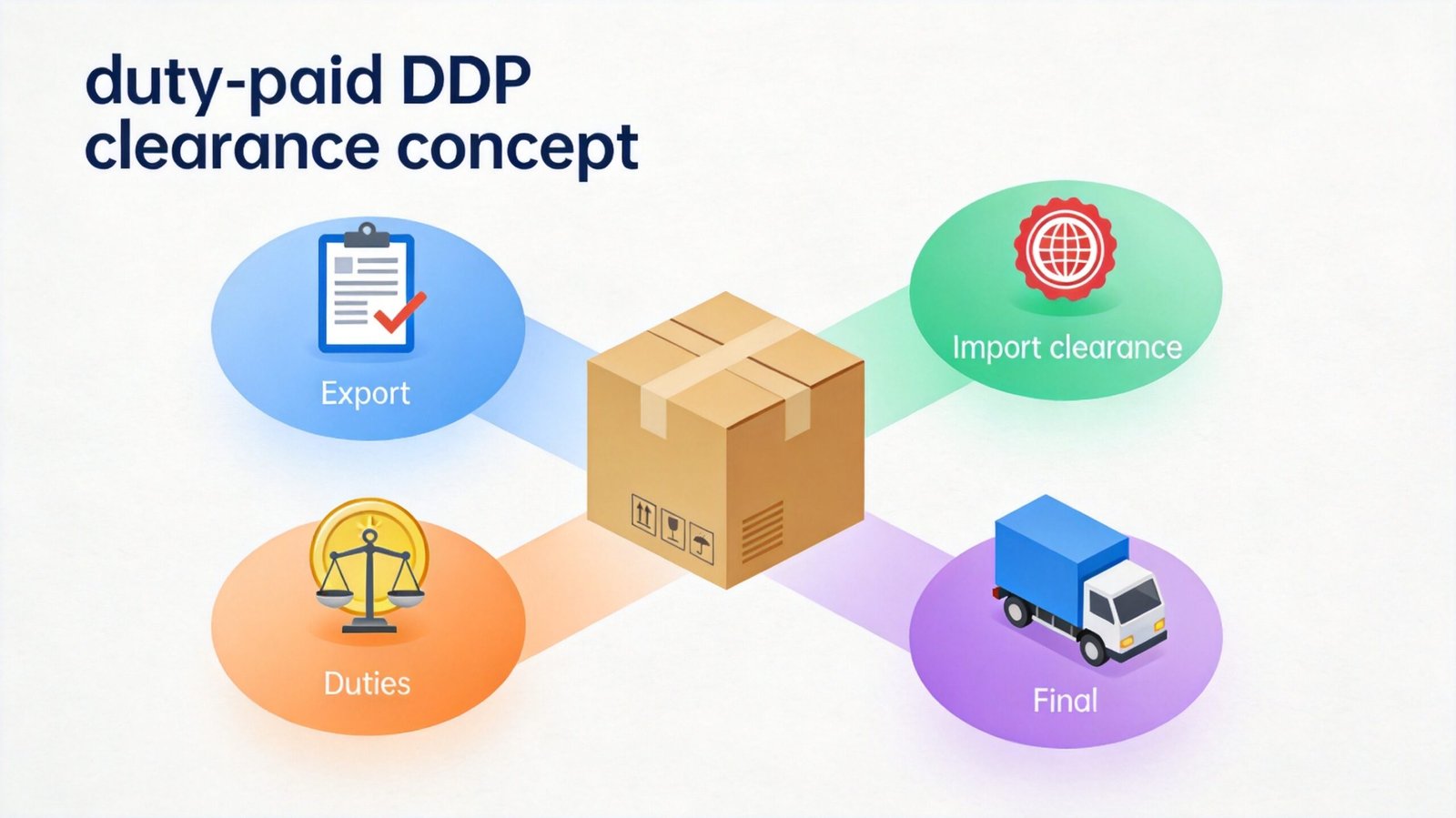
The term “duty-paid” (and its close relative, DDP) describes a commercial arrangement where the seller or the freight provider assumes responsibility for getting goods through both sides of the border. For branded goods air freight to the US, that means:
- Export declaration on the China side, where your shipment is declared to leave the country under the correct paperwork and classification.
- US import clearance on the receiving side, where the shipment is presented to US Customs and Border Protection (CBP), duties are assessed, and the shipment is released for delivery.
When a provider quotes you a “duty-paid” price, they are taking on the day-to-day work of clearing and paying the duties and import taxes on your behalf, so you receive a landed price instead of a stack of surprise invoices.
2.2 What “duty-paid” really includes — and what it does not
A true duty-paid service for branded goods air freight to the US typically bundles:
- Air freight from China to the US.
- US import clearance (customs brokerage).
- Customs duties and import taxes (arranged and pre-funded by the provider).
- Local US delivery to the final address.
But “duty-paid” is not a magic phrase that makes all taxes disappear — nor does it mean every fee is bundled. A good provider clearly states whether the quoted price includes duties, import taxes, clearance fees and delivery, or whether any of these are itemized separately. Answering this question up front is the difference between a transparent quote and a nasty surprise at pickup time.
2.3 Who this is for
Branded goods air freight to the US with duty-paid clearance makes the most sense for:
- Brand sellers who want a predictable landed cost per order.
- Authorized distributors importing brand-name products for resale.
- Brand owners replenishing stock at their own US warehouse or selling direct to end customers.
If your volume is small and time-sensitive, air and duty-paid works well. If your goods are bulky and time is flexible, you may want to weigh other options — but this article stays focused on the air lane for branded goods, and on what makes branded goods air freight to the US different from ordinary cargo handling.
One distinction worth making early: branded goods air freight to the US is not the same thing as simply buying air cargo space. Air cargo moves freight from A to B; a duty-paid service moves your branded goods from your dedicated China warehouse all the way to the end customer in the US, with customs and taxes handled under one roof. That distinction is exactly why brand owners choose it — it is a service outcome, not just a mode of transport.
2.4 Why “one responsible party” matters for brand owners
For a small shipment of generic parts, dividing responsibility across a forwarder, a customs broker and a local courier might be tolerable. For branded goods air freight to the US, that fragmentation is exactly where problems hide. When a branded shipment is examined at the border, you need one party to answer for clearance, documentation and communication with the authority — not three providers pointing at each other.
A duty-paid service consolidates that responsibility. One provider owns the export declaration, the US import clearance, the duty arrangement and the final delivery. If something goes wrong, you have a single accountable partner instead of a blame-passing chain. For brand owners, that single line of accountability is often worth more than the price difference itself. When you are choosing branded goods air freight to the US, ask yourself who that accountable partner will be on the day a shipment stalls — and make sure it is someone with a written answer, not a referral you have to chase.
III. The Air Lane and Documentation for Branded Goods
3.1 The typical air lane: China to the US
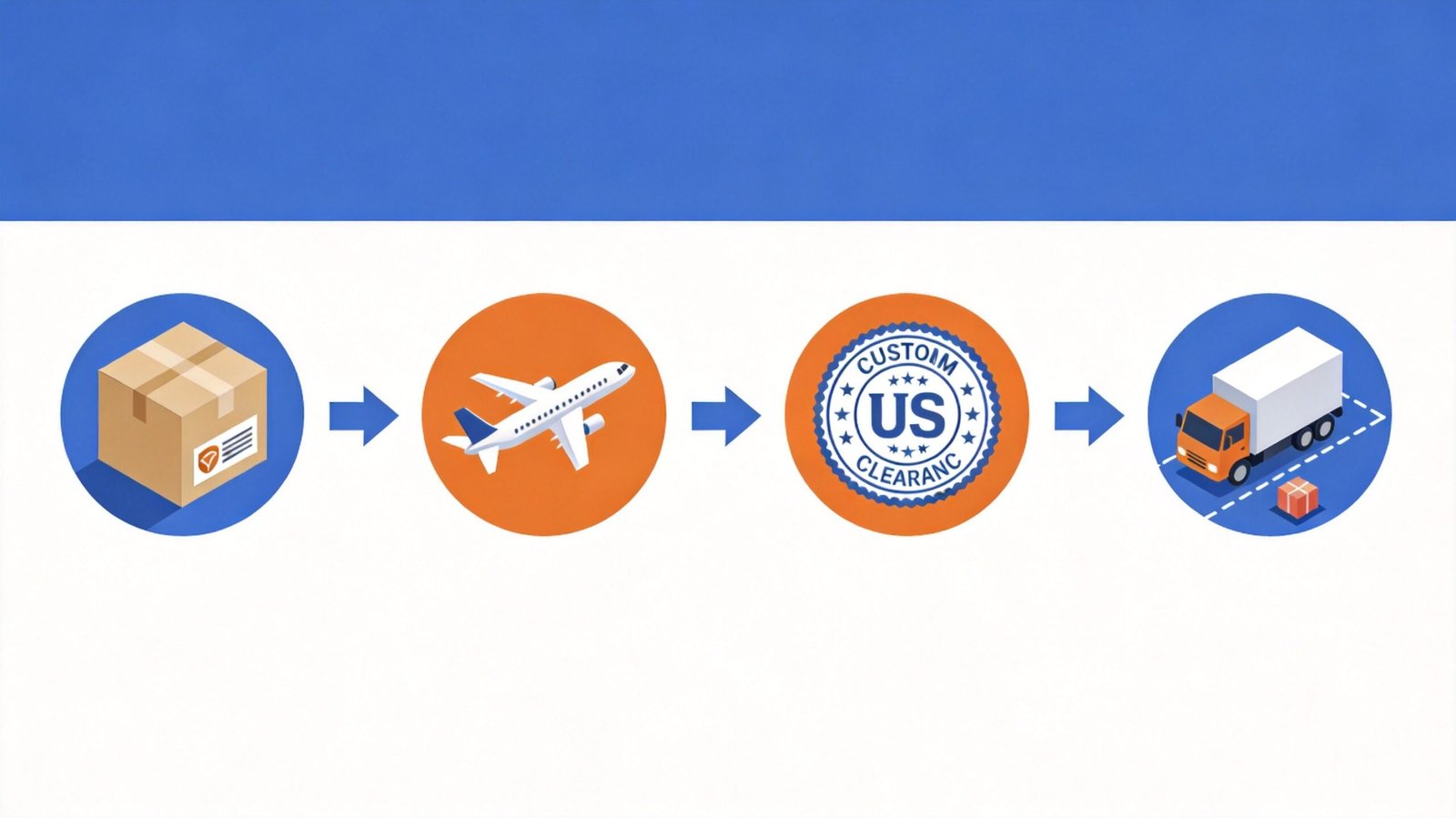
The standard route for branded goods air freight to the US runs from a dedicated consolidation point on the China side (your carrier collects your goods, consolidates them, and arranges the flight) through a major US gateway airport, then on to local clearance and delivery.
A reasonable planning window for routine shipments is on the order of a few business days end to end, depending on flight frequency, whether the flight is direct or via a hub, and how quickly clearance proceeds once the goods land. Ask your provider for a realistic reference transit time and a tracking number so you can follow each stage.
3.2 The documents that make or break your clearance
For branded goods, documentation matters more than for ordinary cargo. The core set usually includes:
- Commercial invoice: product description, quantities, unit value, total value.
- Packing list: how the shipment is packed and what is inside each carton.
- Shipment/tracking number for end-to-end visibility.
- Brand-related documents: authorization or licensing paperwork proving you have the right to import and sell the brand in the US.
The golden rule: declare what you ship, and ship what you declare. A mismatch between the invoice, the packing list and the actual goods is one of the fastest ways to trigger a US Customs examination of a branded shipment.
3.3 HS classification and declared value
US Customs assesses duties based on the Harmonized System (HTS) classification and the declared value. Getting the HTS code right matters: different product categories carry different duty treatment, and routine misclassification can lead to underpayment notices or examination. Declared value should be reasonable and match the commercial reality — too high, and you inflate your own tax base; too low, and you may invite a low-value audit.
A competent provider typically reviews your classification and value with you before you ship, so if yours does not, treat that as a yellow flag.
3.4 What to track when the shipment is in the air
Once your branded goods air freight to the US is airborne, you should be able to see the status move through clear stages: collection on the China side, flight departure, arrival at the US gateway, customs release, and local delivery. If your provider only gives you a vague “it’s on the way,” that is a poor sign.
Good practice is to ask for a tracking number and a written estimate at each stage. When branded goods are involved, the cost of opacity is not just anxiety — it is missed reporting windows, delayed replenishment, and unhappy end customers who were told a delivery date that cannot be verified.
IV. The Special Rules for Branded and Trademarked Goods
4.1 Why branded goods draw more attention at the US border
Counterfeit and trademark-infringing products are a persistent concern for US Customs and Border Protection. As a result, shipments carrying recognizable brand names, logos, or design marks receive more scrutiny than generic cargo. This is not a reason to avoid shipping branded goods — it is a reason to do it right.
The practical implication for legitimate brand owners shipping branded goods air freight to the US is straightforward: authentic goods with proper authorization clear more easily than unverified or potentially infringing goods. If you are an authorized reseller or the brand owner, keep your authorization documents on file and be ready to present them.
4.2 The compliance essentials for brand shipments
When shipping branded goods air freight to the US, keep these points on your checklist:
- Evidence of authenticity and authorization: license agreements, distributor authorizations, or purchase documentation showing a legitimate chain.
- Accurate declarations: never declare a branded item as an unrelated generic product to “simplify” clearance — that is the kind of shortcut that gets shipments seized or the account flagged.
- Consistent value: keep declared value consistent across invoice, packing list and any supporting purchase records.
4.3 Which branded categories fit air DDP best
In practice, the following branded categories move most smoothly through branded goods air freight to the US with duty-paid clearance:
- Apparel, footwear and bags.
- 3C electronics and accessories.
- Beauty and personal care products.
These are typically higher-value, higher-turnover items where a predictable landed cost — the whole point of branded goods air freight to the US — is worth paying for. If your category is regulated or restricted (batteries, certain chemicals, some health products), extra documentation and handling apply — check with your provider before booking.
4.4 A compliance mindset, not just a checklist
Across every category, the common thread is mindset. A provider that treats branded goods air freight to the US as a routine commodity shipment is likely to under-prepare for the trademark scrutiny that branded cargo attracts. A provider that understands brand goods builds that awareness into every step: how it labels cartons, how it writes invoices, how it files declarations, and how it handles a sudden examination request.
In practice this means asking a few pointed questions before you commit: Does the provider ask me for brand authorization documents proactively, or only after a problem? Do they flag high-risk categories before I ship, or let me find out at the border? The answers tell you whether you are working with a partner or just a ticket seller.
V. Cost Structure and How to Estimate It
Even though we avoid listing specific dollar figures here, understanding how the cost is built lets you compare provider quotes fairly and avoid being misled by a low “surface price.”
5.1 What you are actually paying for
A duty-paid quote for branded goods air freight to the US usually reflects five components:
- Air freight, charged by actual weight or volumetric weight, whichever is greater.
- Export handling on the China side.
- Duties and import taxes, pre-funded and arranged by the provider.
- Clearance/entry processing at the US end.
- Local US delivery to the final address.
5.2 The variables that drive the price
- Weight and volume: air freight bills on the greater of actual and volumetric weight. Bulky but light shipments (“light cargo” or “high-volume cargo”) can see their billable weight jump — ask whether the rate is on actual weight or volumetric weight before you compare.
- HTS classification and declared value: both influence the duty and import tax base.
- Service tier: standard versus expedited lanes carry different air costs.
- Provider risk pricing: a duty-paid provider prices in the risk of examination and tax fluctuation. This is a legitimate source of price differences — and exactly why you should compare who takes the risk, not just who quotes lowest.
5.3 A quick way to estimate your landed cost
Take these four steps with any quote:
- Confirm the net pricing basis: is it “freight plus taxes, itemized” or “one delivered duty-paid price”?
- Ask which items are included: duties, import taxes, clearance, final delivery — and which are extra.
- Recompute for your own shipment: is the rate on actual weight or volumetric weight?
- For branded or high-value goods, confirm who bears the risk if the shipment is examined or additional duty is assessed.
A useful mental model: for branded goods air freight to the US, you are not really comparing “shipping prices” — you are comparing how much uncertainty each provider removes from your supply chain. Two quotes can look nearly identical in dollars while differing enormously in what happens when customs asks questions. For branded goods air freight to the US, estimate not only the price, but the cost of a surprise: a delayed restock, a missed sale, a disputed duty assessment. When you price it that way, the slightly higher but fully accountable quote often turns out to be the cheaper one.
VI. Common Pitfalls and Compliance Risk
6.1 Five pitfalls in US branded air shipments
- Low quote, added cost at arrival: a provider baits with a cheap rate, then adds “unexpected duties” or “volumetric re-weighting” fees. Fix: get the included and extra items in writing before shipping.
- “Duty-paid” that is not fully inclusive: the quote says duty-paid but duties, import taxes and clearance fees are all re-billed. Fix: confirm exactly what is covered.
- Gray-channel shortcuts: some cheap options route around formal clearance. It looks cheaper today and becomes a much bigger problem if examined under branded goods air freight to the US compliance rules. Fix: choose a provider with a traceable, compliant chain.
- Risk shifted to you when clearance fails: when a shipment is held, the provider blames “incorrect declaration.” Fix: work with your provider on accurate, complete documentation up front.
- Unclear loss and delay liability: no clear rule for lost or delayed shipments. Fix: confirm the loss protection and delay handling before you ship.
These five pitfalls are common enough that experienced importers treat them as a filter: if a provider cannot or will not answer the first, third or fifth point in writing, that provider is not ready for branded goods air freight to the US. The surface price can look identical across several quotes, but the behavior around these five points is where the real difference between providers lives.
6.2 How to tell a compliant provider from a gray channel
Three checks do most of the work:
- A formal clearance chain: a compliant provider files proper export and import declarations and can trace the whole journey; a gray channel often has no complete document trail.
- A clear liability boundary: a professional provider writes down who bears what risk; a gray channel is vague on purpose.
- A price that is not suspiciously below market: an unusually low price usually comes with compromises somewhere in clearance or service.
6.3 Documentation list and responsibility boundary
Shipment essentials: commercial invoice, packing list, tracking number, product names, HS/HTS codes, and declared value. For branded goods: add authorization or licensing documents proving your right to import and sell the brand.
Before you book your next branded goods air freight to the US shipment, confirm the responsibility boundary in writing: is loss covered, how is delay defined, and who is responsible if a duty dispute arises. These are not topics to open after something goes wrong — they are the terms you pin down before you hand your branded goods to a stranger halfway around the world.
6.4 What real brand owners tell us they check
Over time, experienced importers of branded goods tend to converge on a few non-negotiable checks. They verify the provider’s capability with branded goods air freight to the US specifically — not its general freight volume. They ask to see how prior brand-name shipments cleared, and whether the provider has dedicated staff for trademark-related documentation. They confirm the provider will represent them to US Customs rather than requiring the end customer to self-clear. And they test the provider’s response time to a “what if” question, because a slow answer before shipping predicts a slower answer when a shipment is actually sitting in a bonded warehouse. These checks are cheap to run and repeatedly prove worth more than any price discount.
VII. Checklist and Conclusion
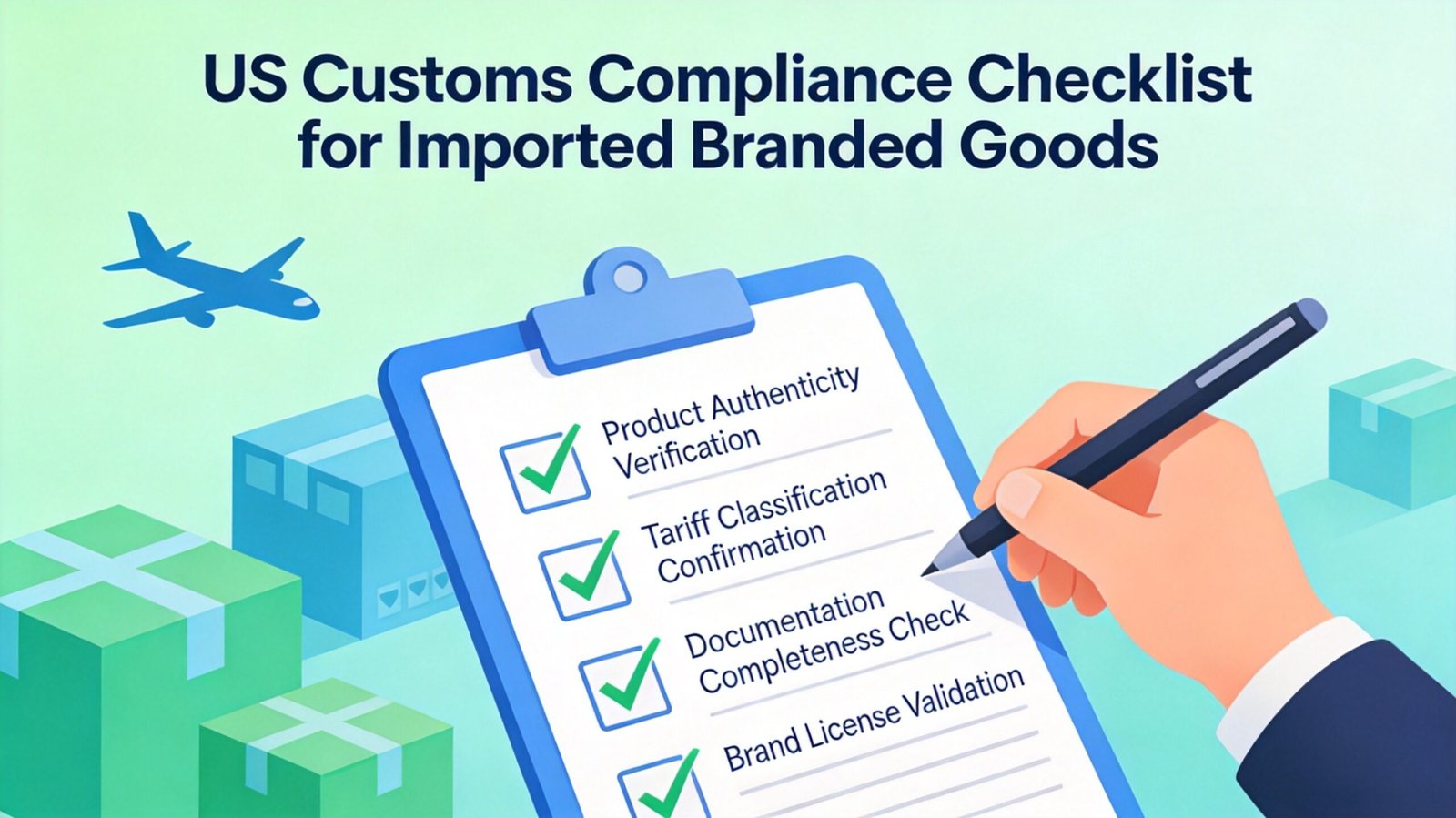
Branded goods air freight to the US with duty-paid clearance is, at its core, a way to convert the uncertainties of international air shipping — complex clearance, fluctuating duties, unpredictable timelines — into one controlled, predictable, traceable delivered price.
If you are a brand seller, an authorized distributor, or a brand owner expanding into the US market, keep this checklist in front of you:
Pre-shipment checklist for branded goods:
- ☐ Confirm product names, HS/HTS classification and declared value are accurate and consistent.
- ☐ Confirm the lane is a formal, traceable clearance chain — not a gray channel.
- ☐ Confirm whether the quote is a single delivered duty-paid price or freight-plus-taxes, and which items are included.
- ☐ Confirm whether brand authorization documents are needed for my goods, and that they are ready.
- ☐ Confirm loss protection, delay handling and duty-dispute responsibility in writing before shipping.
To be clear, no single provider is right for every shipper, and cheap is not automatically bad. What matters is that whoever handles your branded goods air freight to the US can demonstrate three things: a traceable clearance chain, an itemized and honest cost structure, and a written responsibility boundary. Whatever your brand, whatever your volume, whichever gateway airport your goods pass through, these three checks will carry you further than any price list, and they are the same checks that separate a reliable duty-paid partner from a loose booking.
Plan your shipment as a supply-chain decision, not a one-off air booking. Prepare your documentation in advance, pre-negotiate the terms that matter if customs asks questions, and choose a partner who treats your branded goods air freight to the US with the same seriousness as you treat your brand. Follow these five steps, and shipping your branded goods to the US stops being a gamble and starts being a decision you can make with confidence.
For shippers who rely on branded goods air freight to the US to move seasonal or replenishment stock, timing is everything. A provider that balances branded goods air freight to the US with a realistic transit estimate, proactive clearance communication and a single point of accountability will keep your goods moving long after the booking is placed.
In short, the value of branded goods air freight to the US comes not from the airfare alone but from the certainty it brings to your whole supply chain. Choose the partner who treats every shipment as a compliance matter, and your brand-to-US air program becomes a repeatable, dependable advantage rather than a monthly risk.
Whatever your brand and your volume, treat branded goods air freight to the US as a systems decision: accurate declaration, a compliant air lane, transparent all-in pricing and a written accountability boundary. Get those four right, and branded goods air freight to the US becomes a dependable, repeatable advantage for your US sales.