






Shipping to Europe DDP: 2026 Guide to Door-to-Door Delivery from China
On 1 July 2026, the rulebook for selling Chinese goods into the European Union changed. The €150 duty-free allowance for low-value imports was abolished, so every commercial consignment entering the EU — regardless of value — is now potentially liable for customs duty. In the same period, EU enforcement action against low-value parcel platforms signalled that undervalued and misclassified declarations count as deliberate non-compliance. For Chinese exporters, sourcing agents and e-commerce brands, the practical consequence is simple: shipping to Europe DDP (Delivered Duty Paid) has moved from a premium option to the default model for keeping goods moving and customers happy.
Why this matters more in 2026: the old pattern — pricing parcels just under €150 and leaving any border bill to the consignee — no longer works at any value. Buyers hit with unexpected duty and VAT demands refuse delivery, file disputes and leave one-star reviews. With DDP shipping to Europe, those charges are settled before the border, so the unboxing experience is exactly what the customer paid for.
This guide explains what DDP shipping to Europe covers under the 2026 rules: VAT, IOSS and the new flat duty; mode transit times; clearance differences between major markets; and required documents — for B2B importers, Amazon FBA sellers and e-commerce brands sourcing in China, for whom shipping to Europe DDP is now the safe default.
1. What Does Shipping to Europe DDP Mean in 2026?
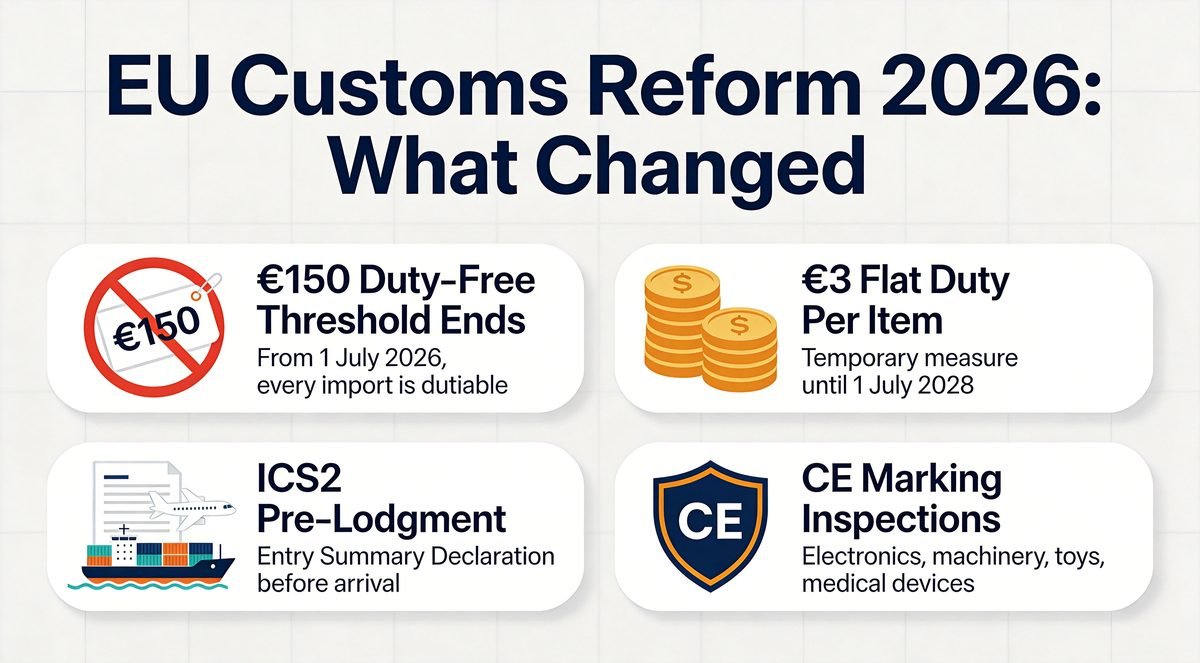
DDP — Delivered Duty Paid — is the Incoterms 2020 term under which the seller bears all responsibility, risk and cost until goods arrive at the buyer’s premises. When you arrange shipping to Europe DDP, your forwarder manages the whole chain as one contracted service:
- Pickup and consolidation in China — collection from your factory or multiple suppliers, with inspection, packaging reinforcement and loading or consolidation.
- Chinese export declaration — booking, shipping instructions and export formalities at the port, airport or rail terminal.
- International main carriage — ocean, air, rail or truck transport to the EU entry point, with milestone tracking.
- EU import clearance — the forwarder’s EU entity files the import declaration, answers customs queries and acts as importer of record where required.
- Duty and VAT settlement — customs duty, the temporary flat duty on low-value consignments and import VAT are paid before release, via IOSS for eligible B2C parcels or formal import procedures.
- Last-mile delivery — cleared cargo goes to the consignee’s warehouse, FBA centre, retail address or private door.
The buyer gets one all-in delivered price and pays nothing at the door. That predictability is the point of DDP: landed cost is known before the sale, carrier-bill refusals disappear, and the seller controls compliance. In 2026, shipping to Europe DDP also means your partner keeps pace with reform deadlines — flat duty, IOSS data and ICS2 lodgments under one contract.
2. The 2026 EU Customs Reform: What Changed on 1 July
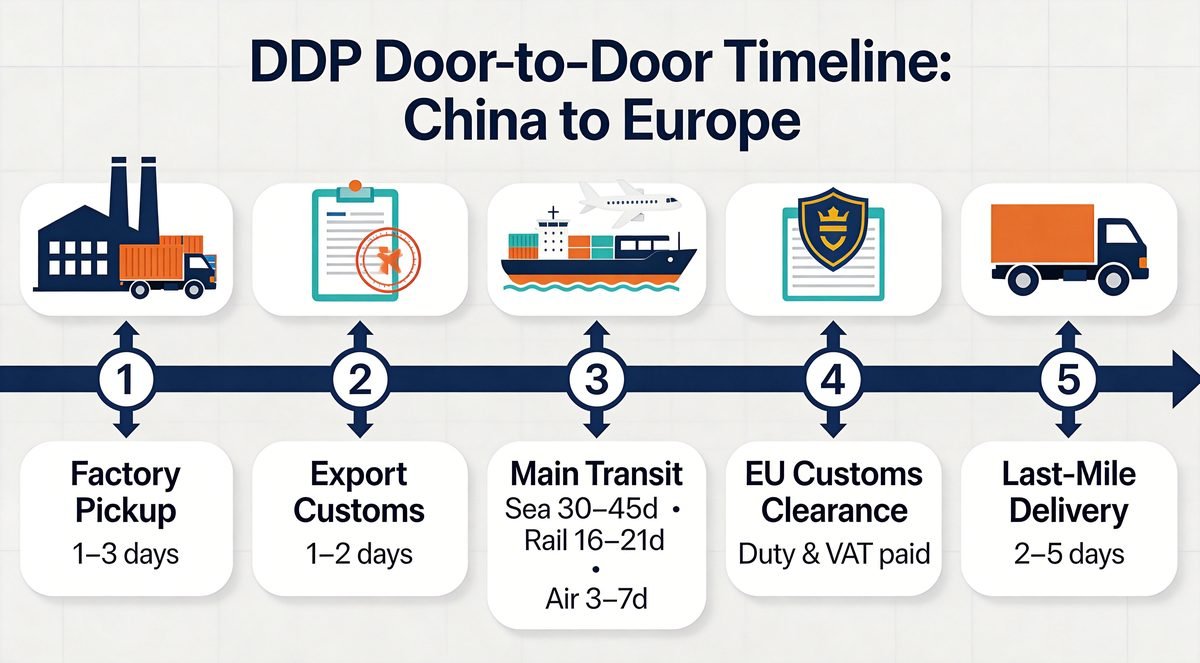
The EU customs reform was originally scheduled for 2028; the EU Council pulled it forward by two years, agreeing in late 2025 and giving final legislative approval on 11 February 2026. Four elements matter for anyone shipping to Europe DDP in 2026–2027:
- The €150 duty-free allowance is abolished. Until 30 June 2026, commercial goods of €150 or less entered the EU duty-free. From 1 July 2026, every consignment from outside the EU is potentially dutiable, whatever its value. A €12 accessory and a €1,200 machine are both in scope; only the rate and paperwork differ.
- A temporary flat duty of €3 per item applies to low-value consignments. For consignments up to €150 declared through IOSS or arriving as postal items, €3 is levied per tariff line — identified mainly by 6-digit CN/HS subheading and country of origin — not per parcel. The Council’s example: one silk blouse and two wool blouses count as two items (different subheadings), so €6 is due. The mechanism runs until 1 July 2028, when the EU Customs Data Hub and simplified duty brackets take over.
- Enforcement on low-value parcels began in May 2026. EU authorities acted against major low-value parcel platforms over undervalued and misclassified declarations. The message: de minimis abuse is now deliberate non-compliance, with retrospective duty assessments and platform restrictions.
- More fees and data are coming. An EU-wide per-parcel handling fee of roughly €2 has been proposed to fund extra customs processing, and later reform stages introduce mandatory line-item product identifiers for B2C imports — treat both as likely near-term additions and check the position before pricing Q4 shipments.
The duty applies however VAT is handled — IOSS, special arrangements or standard import VAT all attract it. This is why shipping to Europe DDP became the default after 1 July: the forwarder counts tariff lines, settles flat or ad valorem duty with customs, and folds it into one delivered price. Track the official position via the European Commission’s Taxation and Customs Union portal.
3. VAT, IOSS and Duty Under DDP: How the Money Flows
VAT and duty are two separate layers — confusing them is 2026’s most expensive seller mistake.
- IOSS handles VAT only. The Import One-Stop Shop lets sellers charge EU VAT at checkout on B2C consignments up to €150, at the customer’s country rate, and remit it through one monthly return. VAT-paid parcels clear faster with no carrier demand note. IOSS never covered customs duty — and from July 2026 that gap is closed.
- Non-EU sellers must appoint an EU intermediary. Sellers established outside the EU cannot register for IOSS directly; an EU-established intermediary registers and files on their behalf and shares joint VAT responsibility. Registration takes time, so arrange it before peak season.
- VAT rates vary by member state. Standard EU rates run 17–27% — Germany 19%, France 20%, Spain 21%, Italy 22% — and checkout pricing must reflect the destination country’s rate.
- The €3 duty interacts with your VAT setup. With IOSS, import VAT is not recharged at the border and the flat duty stays outside the VAT base; without IOSS, import VAT is charged at clearance, the €3 enters the VAT base, and the parcel must clear in the destination state — more brokers, more friction.
Under DDP, the forwarder applies your IOSS number correctly to customs data for eligible parcels and uses its own fiscal representation or formal import VAT channels for consignments above €150 and B2B cargo, so both layers settle before delivery. DDP shipping to Europe does not replace IOSS — it operationalises it. The European Commission’s VAT One-Stop Shop guidance covers IOSS setup; registration is a tax matter for a VAT specialist.
4. Transport Modes Compared: Sea, Air, Rail and Truck
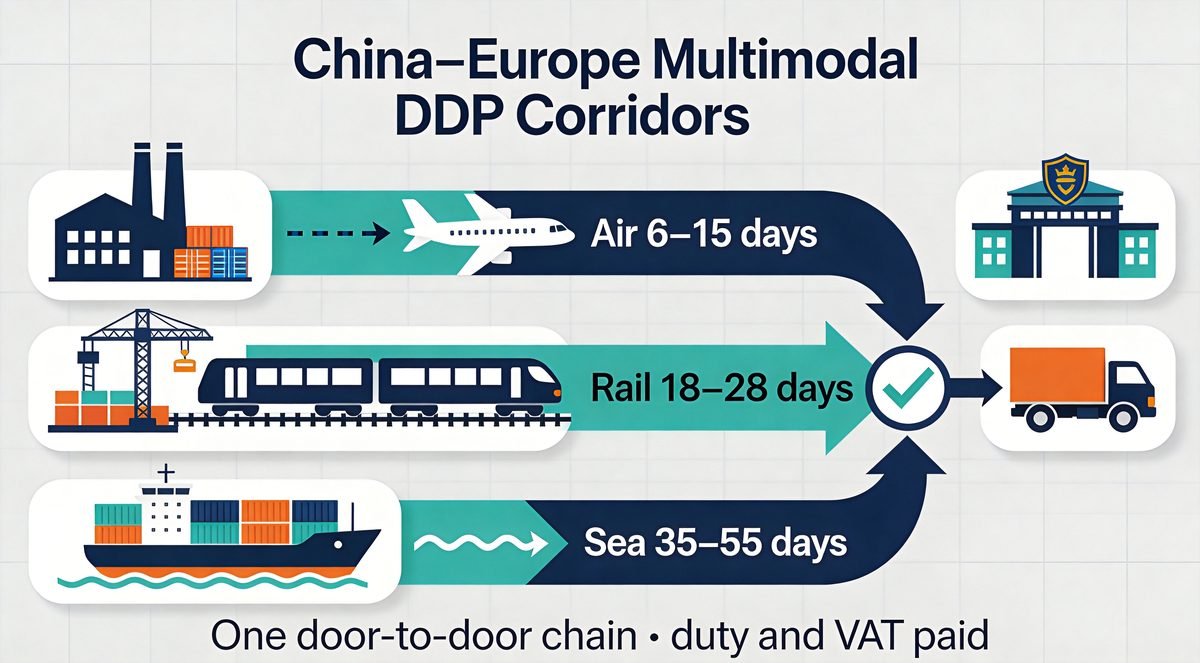
Shipping to Europe DDP runs on four trunk modes. The door-to-door figures below include origin handling, export declaration, main transit, EU clearance and last-mile delivery:
- Sea freight DDP — roughly 35–55 days. The workhorse for bulk replenishment, FBA stock and oversized cargo when shipping to Europe DDP by container. FCL gives the lowest unit cost; LCL suits smaller volumes but adds consolidation time. Allow extra in Q4 for port congestion.
- Air freight DDP — roughly 6–15 days. Express courier lands in about 5–9 days for small high-value parcels; standard air freight takes 6–15 days with clearance — the channel for urgent restocks, samples and time-sensitive lines. Our European air freight DDP special line covers the full door-to-door flow with duty and VAT prepaid.
- China–Europe rail DDP — roughly 18–28 days. The China-Europe Railway Express fills the middle ground between sea and air cost, with services such as Yiwu–Madrid and Chengdu–Tilburg running regular departures. DDP shipping to Europe by rail suits medium-volume consumer goods that cannot wait for a vessel but do not justify air rates; reefer, dangerous goods and oversized cargo are generally excluded.
- Truck freight DDP — roughly 25–35 days. Overland road services via the central corridor offer flexible loading for cargo awkward for rail. Shipping to Europe DDP by truck suits urgent LCL volumes and cross-border e-commerce cargo bound for central EU markets.
One 2026 budget factor: the EU ETS carbon surcharge on Europe-bound sea freight is at 100% implementation, usually itemised as an ETS line — one more cost a shipping to Europe DDP forwarder bakes into your all-in price. Check Maersk’s operational updates and your forwarder’s advisories before fixing Q3/Q4 bookings.
5. Key Destination Markets: Germany, France, Netherlands, Spain and Italy
EU customs rules are harmonised, but each member state has its own clearance culture and distribution role:
- Germany is the EU’s largest e-commerce market and the most service-sensitive; valuations and compliance are scrutinised closely, and LUCID packaging registration is mandatory. Most shipping to Europe DDP programmes treat Germany as both destination and distribution gateway.
- France applies 20% VAT and assesses customs value on a CIF basis, so freight flows directly into duty — accurate invoices matter as much as mode choice.
- The Netherlands is the continent’s distribution hub, with well-established VAT deferral (Article 23 licence) letting established importers defer import VAT into periodic returns — a cash-flow edge for high-volume B2B flows.
- Spain offers a two-coast routing choice — Mediterranean and Atlantic ports plus the Yiwu–Madrid rail terminal inland; CE marking enforcement is among the bloc’s strictest.
- Italy is a large consumer market at 22% VAT, where complete documents and accurate HS classification keep clearance moving through its northern gateways.
For large, heavy or out-of-gauge items, our guide to European ocean freight for oversized cargo covers the pitfalls. Whichever gateway is used, professional shipping to Europe DDP arranges the entry declaration, VAT rate and last-mile carrier for the destination country in advance.
6. Compliance Documents You Must Prepare
Customs holds in 2026 are almost always paperwork failures, not physical ones. Before cargo moves, prepare:
- EORI number. Mandatory for any entity lodging customs declarations. One EORI registered in any member state is valid across the EU; non-EU businesses apply where they first conduct customs activity, or use the forwarder’s entity under DDP.
- Consistent invoice and packing list. Seller/buyer details, line-by-line descriptions, quantities, weights, unit values and totals must reconcile exactly. Generic descriptions such as “spare parts” are rejected; mark the shipment clearly as B2B or B2C.
- Accurate HS/CN classification. The Combined Nomenclature code sets the duty rate, restrictions and the number of €3 tariff lines on low-value parcels. Classification errors are misdeclarations triggering retrospective duty plus penalties.
- CE marking and test reports. Electronics, machinery, toys and medical devices need valid CE marking with supporting documents; non-compliant goods are detained or destroyed. An EU authorised representative is increasingly required too.
- ICS2 pre-departure data. The Entry Summary Declaration must be lodged through ICS2 before goods reach the first EU point of entry — missing data means the shipment cannot load or is held on arrival.
- IPPC wood packaging marks. Pallets and crating must carry ISPM-15 heat-treatment or fumigation stamps.
- Sector-specific items. Steel, aluminium, cement, fertiliser, hydrogen and electricity importers face CBAM carbon reporting; Germany’s LUCID packaging register and French/Spanish EPR registrations apply to consumer goods. The EU’s import procedures guidance sets the official baseline.
Under DDP shipping to Europe, your forwarder supplies the EU-side EORI and importer-of-record entity, pre-lodges ICS2 data and checks CE and packaging compliance before departure — so complete supplier documents matter at booking, not at the border.
7. DDP vs DAP vs DDU: Which Incoterm to Choose
The three delivered terms differ in one crucial respect: who settles duty and VAT at the EU border.
- DDP (Delivered Duty Paid): the seller/forwarder clears import customs and pays duty and VAT. The buyer owes nothing. This is the correct default for B2C e-commerce, marketplace sellers and any shipper without an EU entity — especially in 2026, when a surprise carrier invoice on a €20 order triggers refusals and one-star reviews. Every shipping to Europe DDP programme is built on this risk transfer.
- DAP (Delivered at Place): the seller delivers to the named place but the buyer handles import clearance, duty and VAT. DAP works for established B2B importers that hold their own EORI and VAT number, can reclaim import VAT and want VAT deferral for cash-flow reasons. It is a poor fit for consumer sales, where shipping to Europe DDP is the responsible choice.
- DDU (Delivered Duty Unpaid): the legacy term replaced by DAP in Incoterms 2020; buyers increasingly refuse goods delivered with taxes unpaid.
Rule of thumb for DDP shipping to Europe: if your customer is a private consumer, an FBA centre or a first-time importer without a tax team, use DDP. If they are an established B2B importer with EU VAT registration and in-house brokerage, DAP with deferral can cost less. The same delivered-duty logic applies beyond the EU — our Middle East DDP door-to-door guide shows it across multi-destination lanes.
8. Common Mistakes That Cause Customs Holds
- Guessing the HS code to chase a lower rate. Customs reclassify at the border, bringing a higher assessment, a hold and a penalty record — and each distinct subheading adds a line of the €3 duty.
- Under-declaring value. Invoices below the real transaction price were exactly what the May 2026 enforcement wave targeted; customs can audit back several years, and ultra-cheap “tax-included” channels built on systematic under-declaration put your store at risk.
- Mixing DDP and DAP lines on one invoice. Tax-included and tax-unpaid goods on one document confuse brokers and stall release — split shipments or align terms before departure.
- Missing CE files or IOSS data. Electronics without CE test reports are detained on sight, and B2C parcels without a valid IOSS number clear in the destination state with VAT collected from the consignee plus handling fees.
- Ignoring packaging and product rules. Missing LUCID or EPR registration, unmarked wood packaging or absent CBAM data each produce avoidable holds.
All five mistakes share one root: treating customs as a formality instead of a data process. DDP shipping to Europe shifts execution to the forwarder, but accurate valuations, real HS codes and complete product files are what clear in days rather than weeks.
9. Conclusion: Plan Your EU DDP Chain Before Peak Season
The 2026 reform ended the loophole that made low-value China–EU shipping frictionless — it did not make the lane harder for professional sellers, only for sloppy ones. With the €150 threshold gone, the €3 flat duty in force, IOSS handling VAT at checkout and CE/EORI/ICS2 data expected on every consignment, shipping to Europe DDP turns patchwork border risk into one predictable delivered cost. Choose mode by volume and urgency, register IOSS and your intermediary early, keep documents consistent, and put clearance in the hands of a forwarder with real EU customs operations.
If you buy from multiple Chinese suppliers, consolidation makes DDP shipping to Europe even cleaner: cargo from every factory is collected, inspected and loaded under one document set — see our China consolidation service. Contact our freight team with your product list, HS codes, destination and volume, and we will build a door-to-door Europe DDP plan — mode, transit window, tax path and delivered price — for your next shipment.
Frequently Asked Questions
Q1: After 1 July 2026, do parcels under €150 still pay customs duty?
Yes. The €150 duty-free exemption ended on 1 July 2026. Low-value consignments now carry a temporary flat duty of €3 per tariff line (per distinct 6-digit HS subheading) via IOSS or postal channels until 1 July 2028; consignments above €150 and non-IOSS flows pay normal TARIC rates. Under shipping to Europe DDP, the forwarder settles this duty before delivery.
Q2: I already have IOSS — do I still need DDP?
For VAT, IOSS covers you: VAT is collected at checkout and not recharged at the border. But IOSS has never covered customs duty, and duty now applies at every value. Shipping to Europe DDP adds the duty layer, correct IOSS data handling, clearance and last-mile delivery in one service — IOSS alone is no longer enough.
Q3: How long does DDP shipping from China to Europe take by each mode?
Door to door, clearance and delivery included: shipping to Europe DDP by sea takes roughly 35–55 days, rail around 18–28 days, truck around 25–35 days, air freight around 6–15 days, and express courier about 5–9 days for small parcels. Add Q4 buffer for port congestion and peak surcharges.
Q4: Do I need my own EU VAT number when shipping to Europe DDP?
Usually not for the DDP delivery itself: the forwarder clears through its own EU entity or fiscal representative and settles duty and import VAT on your behalf. But if you store stock in the EU (FBA or third-party warehouses), sell cross-border within the EU or run your own IOSS registration, you still need EU VAT registrations and an intermediary — confirm your setup with a VAT adviser.
Q5: Can Amazon FBA Europe shipments go DDP?
Yes, and it is recommended. Amazon will not act as importer of record or pay duty and VAT, so FBA stock must arrive pre-cleared. DDP shipping to Europe settles customs, duty and VAT before the fulfilment centre, preventing stranded inventory and listing disruptions. Provide FBA box and pallet labels at booking.