









Incoterms 2020 FOB, CIF and DDP Explained for Importers
Introduction
When you are moving goods internationally, the phrase you will hear again and again is Incoterms 2020 — the set of rules that define who arranges what, who pays for what, and who takes responsibility at each point of an international sale. Understanding Incoterms 2020 is not a nice-to-have for anyone buying or selling across borders; it is the foundation on which every shipment is agreed, priced, and executed.
This guide focuses on the three terms importers encounter most: FOB, CIF, and DDP. These three sit at very different points along the journey, and choosing between them changes your cost, your control, and your risk in meaningful ways. We will explain what each term means, where the responsibility transfers, and how to pick the right one for your business and your cargo. Along the way we will keep things practical and avoid specific figures, because the point is to help you understand the logic, not memorize numbers.
A quick note before we dive in: the rules that we call Incoterms 2020 update periodically, and while the fundamentals here are stable, your commercial contracts should always reference the current edition clearly. Used correctly, a clear Incoterms 2020 term in your contract removes a huge amount of ambiguity about who does what. Used vaguely, it is a recipe for disputes. This guide will give you the clarity you need to use them properly.
1. What Incoterms are and why they matter
1.1 The purpose of the rules
At the simplest level, Incoterms 2020 is a set of standardized international rules that allocate tasks, costs, and risks between a buyer and a seller. They were created so that two parties in different countries could agree on a shipment using a short, understood code instead of writing a long description every time. When you see a term like FOB or DDP on an order, everyone involved knows roughly what it means.
The value is enormous. Without such standards, each cross-border deal would require negotiating, clarifying, and writing out exactly who loads the truck, who books the ship, who clears customs, and who bears the risk if goods are lost at sea. A shared set of rules collapses all of that into a single agreed term. That is why Incoterms 2020 is referenced in sales agreements, purchase orders, invoices, and freight bookings around the world.
It is worth remembering that Incoterms 2020 deals with the delivery of goods and the allocation of cost and risk along the way — it does not by itself transfer ownership of the goods, and it is not a complete commercial contract. Those other matters are handled by your broader sales terms. But as a precise, shared language for the logistics part of a transaction, Incoterms 2020 is the standard that keeps international trade orderly.
There is a deeper reason the rules earn their importance in practice. When two experienced logistics people speak, Incoterms 2020 lets them communicate a complex division of responsibility in a single sentence, and that precision cascades down into correct bookings, correct insurance, and correct customs filings. A misunderstanding at this stage — say, assuming CIF covers the risk at sea, or expecting FOB to reach your door — rarely stays small; it tends to surface as a dispute or a delay when the goods are already in motion. Getting the term right at the start, and writing it down, is one of the simplest ways a shipper or importer can protect a transaction that is about to cross several borders and legal systems.
1.2 The three you need to know
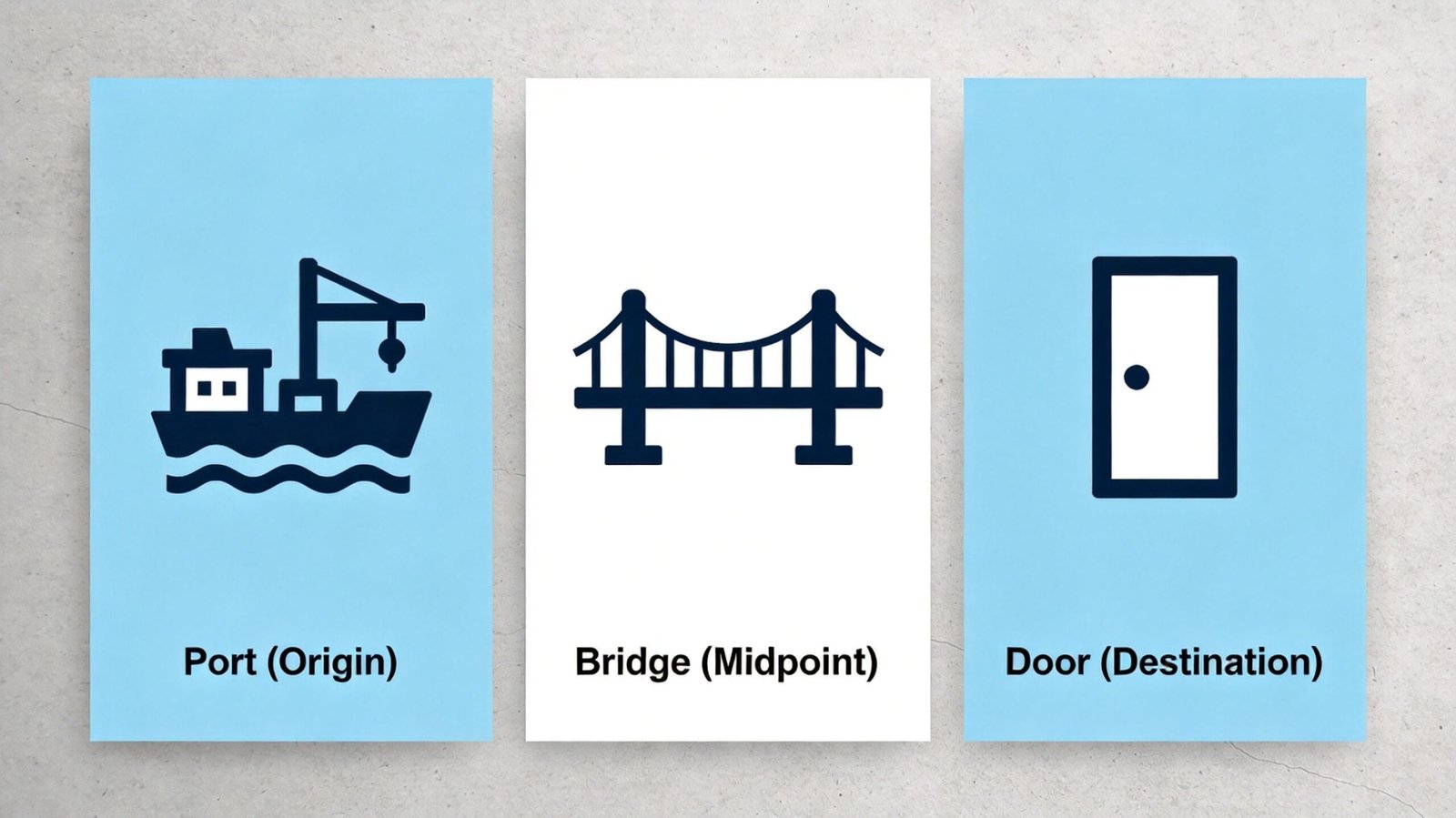
Of the eleven terms in Incoterms 2020, an importer will realistically use a handful. This guide concentrates on FOB, CIF, and DDP, because together they span the realistic range of choices for buying goods internationally:
- FOB (Free On Board) transfers responsibility at the port of shipment, once goods are loaded on board the vessel.
- CIF (Cost, Insurance and Freight) also transfers responsibility at the port of shipment, but the seller pays freight and insurance to the destination port.
- DDP (Delivered Duty Paid) is the most complete, with the seller delivering goods to the buyer’s door, duty paid.
Understanding where each of these sits on the journey is the key to choosing well. As a rough mental map, FOB gives you control and responsibility early, CIF buys you some insurance and freight coverage while shifting the sea risk, and DDP hands nearly everything to the seller. The right choice depends on the Incoterms 2020 term that best matches your appetite for risk and your operational capacity.
2. FOB — Free On Board
2.1 Where the responsibility sits
FOB is one of the most widely used Incoterms 2020 rules, especially for sea freight. Under FOB, the seller’s responsibility ends once the goods are loaded on board the vessel at the named port of shipment. From that moment, the risk transfers to the buyer, who is then responsible for the ocean freight, the insurance, and everything that happens until the goods arrive and clear at destination.
For the seller, FOB is clean and limited: deliver the goods to the port, load them on board, and the job is largely done. For the buyer, FOB means you control the booking and the costs from the port onward, which can give you more leverage and clarity over your freight spend, but it also means you carry the risk during the ocean leg. FOB is a natural fit when you have a freight forwarder aligned with buying goods at the point of loading.
Because the buyer is responsible for the sea leg under FOB, delivery times and total cost can vary more for the buyer. You are the one choosing the vessel, the schedule, and the insurance. Some importers prefer this because they keep control; others find it a burden. The trade-off between control and convenience is the very essence of choosing among the Incoterms 2020 options, and it is worth being clear about which side of that trade you want.
2.2 When FOB suits you
FOB works well for importers who already work closely with their forwarder and want to manage the freight and insurance themselves. It is also common when the buyer has better rates or more leverage on the freight than the supplier does. If you have confidence in your logistics partners and want full visibility over the sea freight, FOB puts the controls in your hands.
The important thing is to understand what FOB is not. It is not a delivery-to-your-door service, and it does not cover the destination handling beyond the port in the way a more complete term would. If you choose FOB, build the rest of the chain — ocean freight, insurance, destination clearance, and final delivery — into your own planning with your forwarder. Done well, FOB is a cost-effective, controlled way to buy; done without a plan, it leaves gaps that someone still has to fill.
For many importers beginning their journey, it is worth sitting down with a forwarder and walking through a typical FOB shipment end to end before committing. Seeing exactly what you are responsible for after the goods load reminds you how much of the chain an importer carries under this Incoterms 2020 rule. That exercise, done once, clarifies whether FOB is genuinely a good fit or whether a more complete term would better match your team. The goal is to make the choice from understanding, not habit, so you end up with the Incoterms 2020 term that serves your actual operations best. That clarity saves far more in avoided friction than it costs in time.
3. CIF — Cost, Insurance and Freight
3.1 What the seller covers
CIF stands for Cost, Insurance and Freight, and under this Incoterms 2020 rule the seller pays the freight to bring the goods to the destination port and also arranges insurance for the sea journey. Importantly, the risk under CIF still transfers to the buyer once the goods are on board the vessel at origin — the seller covers the sea freight and insurance costwise, but the buyer bears the risk of loss or damage during transit, with the seller’s insurance providing the cover.
This is the crucial nuance that many people get wrong about CIF. Paying for freight and insurance is not the same as owning the risk. The seller simply funds those costs and secures a policy; the risk of the goods being damaged or lost at sea sits with the buyer. Understanding this distinction is one of the most valuable things you can learn about the Incoterms 2020 rules, because it prevents a costly misunderstanding at the moment something goes wrong.
Under CIF, the seller’s insurance is typically the minimum cover required, and it may not fully reflect what the buyer would want. As the buyer, you should review that cover and decide whether to top it up. Many experienced importers take out their own additional cover even under CIF, precisely because the seller’s default policy may not suit their cargo’s value or risk profile.
3.2 CIF in practice
CIF is most useful when buyer and seller have a straightforward arrangement and the buyer is comfortable with the sea leg being arranged by the seller. It is relatively common in commodity and regular-volume trades where the logistics are well established and the buyer does not necessarily want to manage the freight booking themselves. For many importers, CIF is a comfortable middle ground: the seller handles the shipping paperwork and fees, while the buyer still guards the sea risk.
The practical cautions are worth stating. Because the seller arranges the freight in a CIF arrangement, you may have less control over the specific vessel, routing, and scheduling than you would under FOB. And because the sea risk belongs to you, insurance adequacy matters a lot. Before you accept CIF, review the insurance arrangements and confirm how the goods will be handled on arrival. As with every Incoterms 2020 choice, the term that is best for you depends on the balance of convenience and control you want.
This distinction between paying for freight and owning the risk is subtle enough that even experienced traders sometimes blur it, which is exactly why the wording of a contract matters. When you see “CIF” written on an order, read it against the Incoterms 2020 definition and ask the clarifying questions before you sign: who carries the transit risk, what does the insurance actually cover, and who files the claim if goods are damaged at sea. Going through that small checklist whenever you are offered a CIF term trains you to handle the rule with the care it deserves and prevents the costly discovery of a risk gap after the cargo is on the water.
4. DDP — Delivered Duty Paid
4.1 The seller does (almost) everything
DDP, or Delivered Duty Paid, is the most complete Incoterms 2020 rule. Under DDP, the seller is responsible for delivering the goods to the buyer’s stated address, having arranged and paid for the main carriage, destination handling, customs clearance in the country of import, and the applicable duties and taxes. For the buyer, this is the simplest possible arrangement — you receive the goods at your door with all the import formalities already handled.
This is exactly why DDP has become the default in cross-border e-commerce and why sellers without local import teams love it. The buyer sees one delivered price, the goods arrive ready to be received, and there is no need to engage a customs broker or chase clearance documents. For a business that wants to keep things simple and predictable, DDP takes the administrative weight off the buyer almost entirely.
It is fair to say the seller takes on significant responsibility and cost under DDP, including duties and taxes they must calculate correctly. That is why DDP is typically offered as a packaged service by forwarders who operate import processes in the destination country. For the buyer, the trade-off of DDP is less control and less visibility over the details of the leg — but for many, that is a very acceptable trade for the simplicity it buys.
4.2 DDP and the rise of landed pricing
DDP is particularly attractive for e-commerce and brand owners who want to quote a single landed price to their customers without any surprise import charges at the far end. When you sell on a DDP basis, you can present a final delivered price with confidence, because the forwarder has already accounted for the freight, duties, and taxes in the total. That predictability is a strong selling point and a big reason DDP has grown so popular.
The key to using DDP successfully is choosing a forwarder who genuinely operates door delivery with import clearance rather than merely tacking on a “delivered” label. A well-run DDP service includes accurate duty and tax calculation, compliant import declarations, and reliable final delivery to the address you specify. When all of that works, DDP gives you the smooth, worry-free import experience implied by the clearest of the Incoterms 2020 options. When the operator is weak, those responsibilities surface as problems at the destination.
5. Choosing between FOB, CIF and DDP
5.1 Cost, control, and risk
The choice among FOB, CIF, and DDP is really a choice about where you want cost, control, and risk to sit. FOB gives you the most control over the sea freight and the lowest level of seller involvement, but you carry the sea risk and must manage the onward chain. CIF moves the freight and insurance costs to the seller while leaving the sea risk with you. DDP pushes nearly all responsibility and cost to the seller, giving you simplicity at the price of control. There is no universal right answer.
The decision should follow your situation rather than habit. If you have a strong forwarder relationship and want to manage freight, FOB suits you. If you want the seller to arrange the sea leg but stay alert on insurance, CIF may fit. If you want a simple delivered price and minimal involvement, DDP is the natural choice. Map your cargo volume, your logistics resources, and your tolerance for risk against these three, and the right Incoterms 2020 term will emerge clearly — because each of FOB, CIF, and DDP answers a different version of the same question about who carries the load.
It is also reasonable to use different terms for different parts of your business. A company might buy raw materials FOB to control cost, sell finished goods to one market DDP for simplicity, and use CIF on a regular lane where the relationship is established. The skill is not to pick one forever, but to choose the right rule for each trade. That flexibility is one of the real strengths of the Incoterms 2020 framework.
Once you settle on the term for a given flow, keep it consistent across that product and lane so your forecasters, warehouse staff, and forwarder all build around the same assumption. Inconsistency — switching between FOB, CIF, and DDP shipment to shipment without a plan — creates exactly the sort of confusion that Incoterms 2020 was designed to remove. So document which term applies to which flow, review it a couple of times a year as your volumes change, and adjust deliberately. Small, thoughtful management of your terms keeps the whole operation running on a shared, unambiguous understanding.
5.2 Avoiding the common mistakes
The most common mistakes people make around FOB, CIF, and DDP all come from a misunderstanding of where responsibility actually transfers. The biggest is assuming CIF means the seller owns the risk at sea — it does not. Another is treating FOB as a door-to-door service when it is only a port transfer. A third is underestimating what DDP requires of the seller and assuming it needs no preparation on the buyer’s side at all, even though accurate buyer details are still essential.
A practical safeguard is to put the exact Incoterms 2020 term, with the named port or place, in writing on every order, invoice, and booking. “FOB Guangzhou”, “CIF Rotterdam”, or “DDP [your address]” leaves no room for a dispute about scope. As the buyer, you should also confirm not just the term but what it includes — insurance level under CIF, final delivery scope under DDP, and so on. Clarity up front is the cheapest form of protection in international trade.
There is one more error worth flagging: assuming the term alone settles every cost question. Even under a single Incoterms 2020 rule, there are incidental items — terminal handling, local charges, documentation fees — that may or may not be included depending on the exact wording and the market. Rather than assume, ask your forwarder to spell out what is inside the quoted term and what is separate. This habit is especially important under DDP, where the boundary between the seller’s duty-paid scope and any local charges can vary. Confirming these small points keeps an Incoterms 2020 term from quietly becoming a source of disagreement when the final bill arrives.
6. A practical summary
If you remember only a few things from this guide, hold onto these. FOB hands you the sea leg and its risk; plan the onward chain yourself. CIF lets the seller pay for freight and insurance, but the sea risk still sits with you — check the cover. DDP delivers to your door duty paid, making the buyer simplest but the seller most responsible. Match each Incoterms 2020 term to your volume, your resources, and your appetite for risk, and name the place explicitly on every document.
Whichever term you choose, build a close relationship with a forwarder who can operate it well. Under FOB you need a partner to manage your sea leg; under CIF you need help reviewing insurance and arrival handling. Under DDP you depend on a forwarder who can genuinely clear and deliver at the destination. The right term and the right partner together are what turn international trade from a source of anxiety into a dependable part of your business — and it is precisely why mastering Incoterms 2020, even just the three terms covered here, pays off so reliably.
Conclusion
Incoterms 2020 is far more than a list of shipping abbreviations; it is the shared language that lets buyers and sellers across borders agree on who does what, who pays for what, and who bears the risk, without writing a long contract every time. FOB, CIF, and DDP each sit at a different point on the journey, and each balances cost, control, and risk differently. Understanding those differences lets you buy and sell with clarity and confidence.
You do not need to master all eleven terms to trade effectively. Choose the few that fit your business — for most importers, that is FOB, CIF, and DDP — understand exactly where responsibility transfers under each Incoterms 2020 rule, and write the named place into every document. Pair that clarity with a capable forwarder, and you will find that even complex international shipments can be arranged smoothly. The knowledge in this guide is the difference between a vague agreement that invites disputes and a precise one that lets your goods — and your business — simply keep moving.