










Air Cargo Consolidation and Dedicated Lanes: Balancing Speed and Cost
Introduction
When your business depends on moving goods by air, one of the most important decisions you will make is not which airline to use, but how your cargo is grouped and routed. The two most common approaches — air cargo consolidation and dedicated air freight lanes — solve the same problem in very different ways, and understanding the difference is the key to balancing speed, cost, and reliability for your shipments.
This guide explains both methods in practical terms. We will look at how air cargo consolidation works, what a dedicated lane actually is, how they compare on speed and cost, and how to choose the right approach for different types of cargo. We will keep it focused and avoid specific figures, because the goal is to give you a clear framework for decision-making rather than a set of numbers that will date quickly.
Before we go further, one useful way to think about it: air cargo consolidation is about sharing space to control cost, while a dedicated lane is about reserving capacity and structure to guarantee speed and reliability. Most growing businesses end up using both — consolidation for routine, less urgent shipments, and dedicated lanes for the cargo that simply has to arrive on time. The skill is knowing which cargo belongs on which path, and that is exactly what this guide will help you decide. If you take the time to understand both, you will stop seeing air freight as a single expensive choice and start seeing it as a set of options you can tune to fit every shipment.
1. What air cargo consolidation is
1.1 Sharing the space on the aircraft
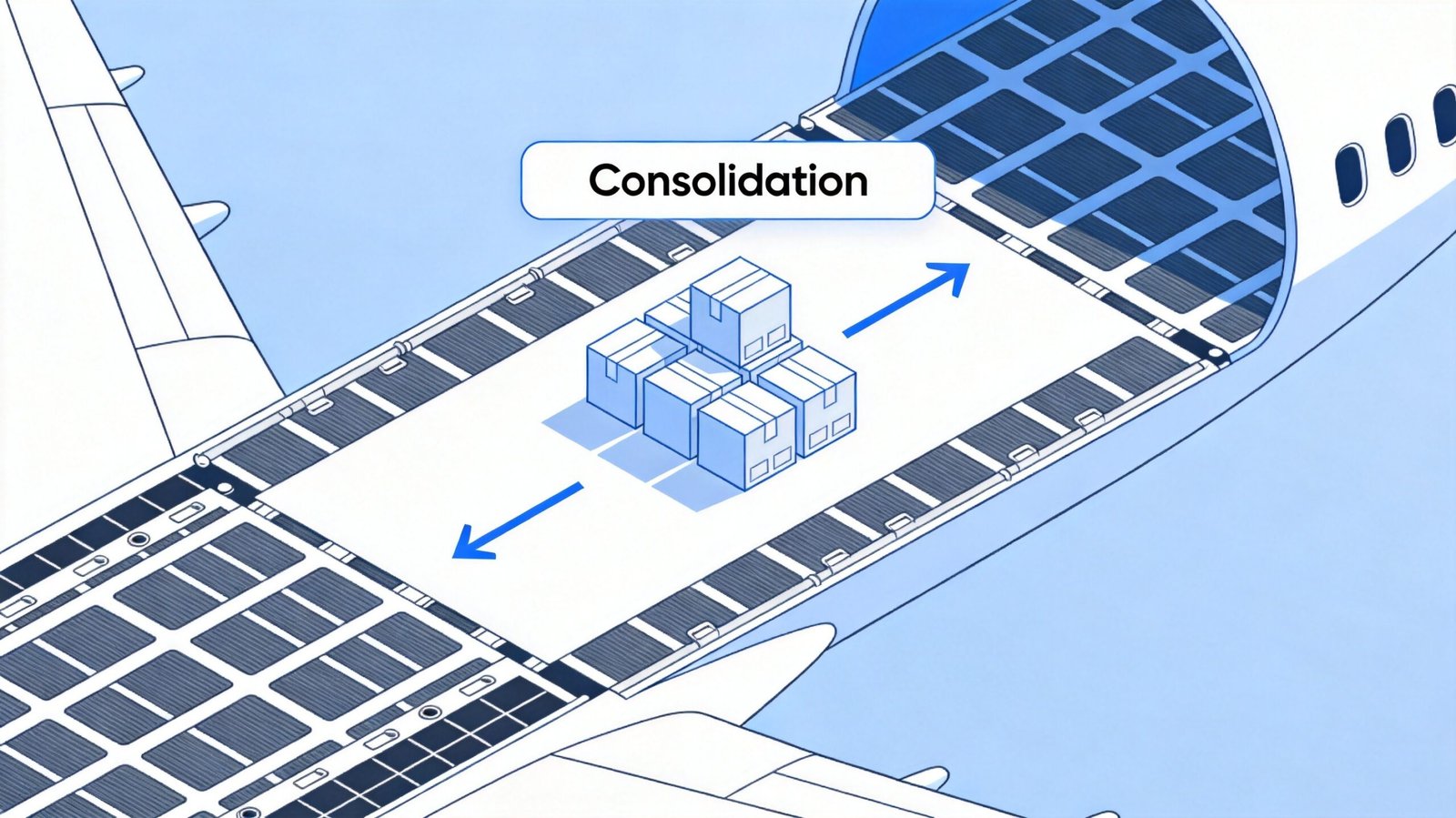
Air cargo consolidation is the practice of combining multiple shippers’ cargo into a single booking or single shipment that is then transported as one unit in the air. A forwarder acts as the consolidator: it gathers goods from many clients, groups them by destination, and books space on an aircraft as a block, then splits the cargo back out on arrival. Each shipper pays only for the space or weight their cargo uses, not for their own dedicated allocation of the whole pallet.
The economics are the heart of the model. Aircraft hold space is expensive and fixed, and a forwarder that can fill its allocation with many shipments achieves a better load factor and passes along the benefit. For the individual shipper, this means you do not have to ship a full pallet to access air freight. Whether you are moving a few cartons or a modest volume of goods, air cargo consolidation lets you enjoy predictable air speed and shared cost instead of underwriting your own dedicated space.
Because your cargo travels with others, the consolidation model works best when the forwarder runs frequent, well-organized consolidations on your lane. Regular departures mean your cargo moves without waiting for the group to fill; clean grouping by destination means your cargo is separated and handed over quickly on arrival. The quality of the network is what determines whether air cargo consolidation actually saves you time as well as money.
It is worth emphasizing how much the consolidator’s schedule shapes your experience. In a healthy program, cargo joins a consolidation that departs on a near-continuous rhythm, so lead times stay short and predictable. In a less disciplined one, cargo waits until enough volume accumulates, which stretches your transit and eats into the speed advantage that makes air freight worthwhile in the first place. That is the hidden variable of air cargo consolidation: a great network gives you speed at shared cost, while a slow-to-fill operation costs you the very thing you chose air freight for. When you evaluate a consolidator, ask not just about price but about real departure frequency and how quickly they tend to fill each group.
1.2 How the process flows in practice
Let us trace a typical consolidated shipment. Your goods leave your supplier and arrive at the forwarder’s consolidation point near the departure airport. There your cargo is inspected, documented, and built into a larger air consignment alongside cargo from other shippers. The grouped consignment is loaded onto the aircraft, flies to the destination airport, and is broken down on arrival so your cargo can clear and continue to its final address.
Under consolidation, your cargo is still tracked as its own identifiable unit. You receive a reference tied to your portion of the shipment, even though you are not the only shipper on the aircraft. This is an important mental shift: in air cargo consolidation, you are sharing the transport with others, but your identity, your documents, and your destination handling remain clearly yours. A good forwarder gives you visibility into your portion at every stage, so sharing space never means losing track of your goods.
This unit-level visibility is more than a comfort; it is essential to running a clean operation. Because your cargo is one of many in the group, clear labeling and accurate documents are what allow your portion to be separated correctly at destination and cleared without confusion. In air cargo consolidation, a package that is poorly documented can hold up not just your shipment but the smooth processing of the whole group. So the same documents that protect you personally also protect the shared service. Preparing them carefully is a courtesy to your own cargo and to the other shippers relying on the same consolidation to move on schedule.
2. What a dedicated air cargo lane is
2.1 Reserving structure for reliability
At the other end of the spectrum is the dedicated air lane — a structured, regularly operated route between specific origins and destinations, built to move cargo reliably and predictably. A dedicated lane may be operated by a single airline or by a forwarder that has reserved consistent capacity on that corridor. The defining feature is not ownership of an aircraft, but the structure, frequency, and commitment of the service on that specific route.
A well-run dedicated lane gives your cargo a predictable rhythm: regular scheduled departures, stable transit times, and fewer surprises about when your shipment will move. Because the lane is built around that corridor, the handling, documentation, and destination arrangements are refined and dependable. For cargo that is time-sensitive, high-value, or mission-critical, this reliability is exactly what makes a dedicated lane worth choosing over a general consolidated service. The difference is often most visible in the transparency it buys you: you generally know weeks in advance when your cargo will fly and land, which turns shipping from a source of uncertainty into a scheduled part of your operation.
It is worth clarifying that a dedicated lane does not always mean your cargo flies alone or exclusively. It means the route is operated as a committed, structured service that your forwarder can rely on and reserve within, with consistent capacity set aside for cargo like yours. The value is the dependability of the schedule and the guaranteed space, rather than the exclusivity of the aircraft.
2.2 The dedicated-lane advantage
The main advantage of a dedicated lane is predictable performance. When your customers depend on strict delivery dates, or when delay costs you far more than the freight premium, the stability of a dedicated lane becomes the most valuable property of your entire supply chain. You can plan production, launch schedules, and customer promises around a transit time you can actually trust.
Dedicated lanes also tend to come with more consistent pricing and better service focus, because the forwarder’s team is specialized on that corridor. Working with the same lane repeatedly, they refine their processes, build destination relationships, and resolve exceptions quickly. For time-critical goods, these advantages translate directly into fewer disruptions and more confidence. The trade-off is typically that dedicating or reserving space costs more than sharing it, which brings us to the central comparison of this guide.
There is also a subtler reliability benefit worth recognizing: on a dedicated lane, your cargo benefits from a familiar, exercised process rather than being handled fresh every time. The provider’s staff already know the documentation quirks, the customs expectations, and the destination handling of that corridor, so fewer steps are re-learned on your cargo’s journey. When you contrast that with a general service where every element is generic, it becomes clear why dedicated lanes earn their place despite a higher price. For the right cargo, that certainty is not an indulgence — it is the entire reason to prefer a dedicated lane over shared air cargo consolidation for that particular, high-stakes shipment.
3. Balancing speed and cost
3.1 Where each approach wins
The decision between air cargo consolidation and a dedicated lane usually comes down to a simple trade between cost and certainty. Air cargo consolidation generally wins on cost for routine shipments that can tolerate a degree of flexibility in timing. Because you share the space and the load factor is high, the shared cost is lower — ideal for goods that need to move by air but are not hostage to a single arrival date.
A dedicated lane wins on speed and reliability. If your shipment must arrive by a specific date to support a launch, a promotion, or a customer commitment, the predictable transit of a dedicated lane is worth its extra cost. When you weigh the freight premium against the cost of being late — a missed launch, a disappointed customer, a lost sale — the dedicated lane often proves the cheaper choice in the larger sense, even though its price is higher on the invoice. For that reason, thinking of a dedicated lane purely as “expensive” misses the point; it is expensive per kilo but inexpensive per guaranteed outcome.
The mature approach is to run both in parallel: use air cargo consolidation for the routine portion of your volume to keep average costs down, and route your time-critical cargo onto a dedicated lane where reliability matters most. This hybrid strategy lets you have the economies of sharing for most of your goods and the dependability of structure for the shipments that count. Getting the balance right is the real skill in managing air freight.
To make that balance concrete, think of it as two budgets you hold separately. Your air cargo consolidation budget is set by the volume of routine cargo that can tolerate schedule flexibility and by how much you are willing to pay to keep that volume moving economically. Your dedicated-lane budget is driven by the smaller set of shipments whose on-time arrival genuinely determines revenue, reputation, or customer satisfaction. Reviewing these two budgets each planning cycle — rather than lumping all air spend together — forces you to allocate each shipment to the right method on purpose. Over time, that deliberate split is what turns an ad hoc mix of air cargo consolidation and dedicated lanes into a coherent freight strategy.
3.2 Matching the method to each shipment
Rather than choosing one method for everything, build a simple habit: sort each shipment by how time-sensitive it is, and route it accordingly. Regular replenishment, stock that has lead-time flexibility, and goods with no hard customer date all fit air cargo consolidation well. Time-bound launches, high-value orders, and any cargo where a delay is unacceptable belong on a dedicated lane.
Apply the same logic to cost sensitivity. If your margin is tight and your cargo can wait a little, air cargo consolidation protects your profitability. If your business depends on reputation and punctuality, spending on a dedicated lane protects that reputation. When you can, keep a flexible buffer in your safety stock so that most shipments can ride the cost-efficient consolidated path, with only genuinely urgent or valuable cargo touching the premium dedicated lane. The result is a freight strategy that is both economical and dependable.
A final practical note on this sorting habit: it works best when you make the time-sensitivity decision early, at order time, rather than in a panic near the deadline. Build the routing choice into your order entry so every air booking is tagged as consolidated or dedicated before it reaches the forwarder. That one step removes the scramble, keeps your air cargo consolidation volumes predictable for planning, and reserves your dedicated-lane capacity for the shipments that were always meant to have it. Consistent tagging also gives you clean data over time, showing exactly which cargo belonged on which path — and giving you the evidence to refine your balance of speed and cost as your business grows.
4. Choosing the right air freight partner
4.1 What to look for in a consolidator
Not all consolidators deliver the same quality, and the forwarder’s network is the difference between a smooth consolidated shipment and a frustrating one. Before you trust a forwarder with your air cargo consolidation, verify how frequently they consolidate on your lane, how well they group cargo by destination, and how their break-bulk and final handling are organized at the other end. Frequent consolidation departures mean less waiting; clean destination grouping means faster recovery of your goods on arrival.
Transparency matters just as much. You want a forwarder who shows you your cargo’s progress within the consolidated shipment and who communicates milestone updates honestly. In air cargo consolidation, your goods are co-loaded, so clear communication about schedules and any delays is essential. A consolidator who keeps you informed and owns the process is one you can build a long-term routing plan around. The quality of that communication tells you more than any rate.
A useful test is to ask how the forwarder groups and when it decides to close an air cargo consolidation. A clear, honest answer reveals whether your cargo will move promptly or sit waiting, which is the single biggest source of surprise lead time in air cargo consolidation. Combine that with their real departure frequency on your lane, and you can predict your transit far better than any generic quote. Choosing a consolidator on these operational facts, rather than on price alone, is what separates a reliably fast air operation from one that quietly drifts.
4.2 What to look for in a dedicated-lane provider
When you choose a provider for a dedicated air lane, the emphasis shifts to capability and commitment. Confirm the actual frequency and reliability of the lane to your destination, the service history, and how the provider handles peak periods when capacity is tight. A dedicated lane is only valuable if it consistently delivers, so examine the provider’s real record on the route rather than its promises.
You should also confirm how capacity is protected for your cargo. In a true dedicated-lane arrangement, the provider reserves consistent space that your shipments actually get, even during busy seasons. Ask how they manage the corridor, who your single point of contact is, and how they respond when something goes wrong. For the reliability you are paying for under a dedicated lane, the provider’s operational depth on that specific corridor is the decisive factor.
5. Common pitfalls and a practical checklist
5.1 Mistakes that undo the benefits
Several mistakes undermine the value of both air cargo consolidation and dedicated lanes. The first is choosing consolidation for cargo that actually needed a dedicated lane’s strict date, leaving you exposed to schedule variance. The second is treating a dedicated lane as a commodity and switching providers constantly, losing the relationship and lane expertise you paid for. A third is underestimating documentation, which slows clearance whether you consolidate or dedicate.
Careful planning avoids all three. Be honest about each shipment’s time sensitivity before you book. When you find a provider that performs well on your lane, build a stable relationship rather than churning. And never let documentation become an afterthought, because both approaches depend on clean paperwork for smooth handling and clearance. These habits protect the speed and cost benefits you are trying to secure.
5.2 A pre-booking checklist
Before you book any air shipment, run a quick checklist. Confirm the routing: is this shipment going into an air cargo consolidation, or does it belong on a dedicated lane? Confirm the time sensitivity and the consequence of delay, so you book the right level of reliability. Confirm the departure frequency and the realistic transit range, and confirm how your cargo will be handled and tracked on arrival. Confirm your documents are complete and accurate. And confirm the provider’s record on your specific lane with the service frequency you need. Answering these clearly at booking time keeps your air freight strategy cost-effective and dependable.
Conclusion
Air cargo consolidation and dedicated air lanes are two complementary tools for moving goods by air, and the mature shipper uses both. Air cargo consolidation shares space to keep costs down and is well suited to routine, flexible cargo; a dedicated lane reserves structure and capacity to guarantee speed and reliability for the cargo that counts. Balancing the two — routing routine shipments to consolidation and critical ones to a dedicated lane — lets you keep average costs sensible while protecting your deadlines and reputation.
The essentials are simple. Understand how each method works, sort your shipments by time and cost sensitivity, and choose a forwarder who genuinely operates well on your lane whether that means frequent clean air cargo consolidation or a dependable dedicated corridor. Do that, and you turn air freight from an unpredictable expense into a reliable, balanced part of your supply chain — fast enough when it must be fast, and economical everywhere else. Start by mapping your current shipments against this framework, and the right mix of air cargo consolidation and dedicated lanes will quickly become clear.